By David Castlewitz
The kisses were as sweet as JoAnn remembered them to be when Kevin was alive. She knew this to be a dream, but she welcomed it, craved it, had gone to bed thinking about Kevin, imagining the texture of his body pressed against her own . Although she knew she’d never be with him again, she let her dream-self press his cheeks, thinking it odd that they were soft, without the tiny barbed whiskers that sometimes scratched her. Her lips against his, she wondered why they felt hard, not soft as she remembered them to be. She touched his eyelids with her tongue, then drew back to study him.
The eyes disappeared. Kevin’s lips stretched into a smile that wasn’t a smile. Tiny worms crawled through his nostrils and out from the corners of his eyes. His naked skull slipped sideways, separated from his neck; and blood poured from his body.
JoAnn screamed herself awake.
She sat up in the king-sized bed and scrambled sideways, feet slapping the cold hardwood floor. She sat on the edge of the mattress, sweating, feeling tears that didn’t fall, a cough at the back of her throat that she couldn’t let loose, her hair wet with sweat and draping her bare shoulders.
Three months had passed since Kevin died, taking with him their plans to marry, to build a family and a life together. Three months since the accident when his rental car was slammed by an out-of-control pickup truck. He’d gone to West Virginia to interview for a short-term job providing professional advice to a game developer. Easy work, he said. Work he’d do mostly from their Evanston condo in Crawford House.
“U up,” she tapped into her cell phone. After a minute, she heard the familiar ring tone of her friend Paula.
“You had another Kevin dream, didn’t you?” Paula said.
“A bad one.” JoAnn imagined her friend sitting cross-legged in bed, her soft brown skin wet from an early morning shower.
“And the little girl?”
JoAnn shivered. “Not this time.”
“Why do the two go together? Do you wonder?”
JoAnn looked at the closed bedroom door. Beyond it, the door to her apartment shut out the rest of the old building. Three times now, always after a disturbing dream where Kevin sometimes appeared as fit and robust as he had been in life and other times as a frightening corpse, she heard a child sobbing.
“Talk about something else,” JoAnn said. “You still on that Bangalore project?”
“Any other reason why I’m up and working this early.”
A smile. A flash of perfectly aligned white teeth dashed across JoAnn’s mind. She yearned for the distraction of shop talk, of comparing jobs, of dissecting her friend’s love life.
“We need to meet for lunch,” Paula offered.
JoAnn concentrated on her closed door, fearing that if she opened it she’d see a ghostly presence, a child in a nightgown, perhaps. A warm hollow feeling filled her chest. She breathed deeply, but that didn’t relieve the anxiety.
“I’m going back to sleep, Paula. I’d love to do lunch. Just say when.”
But she didn’t go back to sleep. She went to the bedroom door and yanked it open, daring herself to look into the dark living room, ready to shout at whatever apparition she saw.
She saw nothing. She wall-sized window and looked out at Chicago to the south. Tall buildings hugged Lake Michigan’s coast. Several apartment towers much taller than her building peppered her immediate surroundings, crowding out the town’s quaint composition. Evanston sat close enough to the city to its south that she and Kevin enjoyed its nightlife, its robust theatre environment, and all the culture the urban sprawl offered after a short drive along Lake Shore Drive.
When the child’s plaintive plea rang in her ears, JoAnn fled to the kitchen, flicked on the ceiling lights and hurried to brew a K-cup in the coffee maker. If she ignored what she heard, it would go away. The voice was inside her. It wasn’t real. The only thing in her life that was real was the death of Kevin.
Eyes shut, salty tears unspent, she sipped coffee from a thick white mug emblazoned with a red J. A cold wind wrapped itself around her body. She checked the thermostat on the way to the bathroom to get her terrycloth robe. Sixty-eight degrees. Plenty warm, Kevin would say. Plenty warm.
The child’s cry again. Crawford House didn’t have young children, and no young families. At age 37, she was one of the youngest owners. This building was a relic for couples with offspring who no longer lived with their parents. It was a place for seniors. Serene and quiet, Crawford House stood as firm as its granite building blocks.
JoAnn opened her apartment door and peeked out. Breakfast scents – coffee, bacon, and toast — drifted on the air, making her hungry. On days when she rose this early for a meeting in Chicago, Kevin always got up with her and made scrambled eggs with buttered the toast.
Eyes shut, she sat at the small kitchen table and dozed, enjoying the mental image of her dead lover’s rugged face flushed after a five mile run.
“Who is that kid?” she wondered aloud. Why was a lost child roaming Crawford House?
#
“It’s what happens when someone close to you dies,” Paula said, and looked sideways at a young mother struggling with a toddler, making the kid put on a jacket before leaving the restaurant.
JoAnn pulled a tissue from inside her cuff, a habit leftover from when she was a child.
“Got a cold?”
JoAnn shook her head. “Spring allergies.” Or was it from constant sobs that overcame her at odd moments.
“Some spring. Used to be warm come late-March. Not anymore. Anyway, my grandma always said when someone close dies, you get more spiritual.”
JoAnn shrugged at that. The conversation had grown tedious. Lunch with Paula wasn’t the “girl’s time” she’d anticipated. It wasn’t full of the idle chatter she used to enjoy. Plus, she was tired. Physically. She hadn’t had a Kevin dream in three days, but she was still up at 4 AM, listening for a child’s cries. This morning she dressed and waited, determined to run into the hallway and look for the kid.
“Do you even know if there are children in your building?” Paula said. “Isn’t it like an old folk’s home?”
“Not exactly that.” Maybe some new couple with a toddler had moved in. She didn’t go to condo association meetings. Unlike Kevin, she preferred to keep to herself.
“Guess what?” Paula said, suddenly brightening, her eyes wide. “I’m another step closer to getting my owner’s license.”
“Owner of what?”
“An ID so I can buy a handgun. Legally buy one.”
“You don’t intend to carry it around do you? You get caught with that, just stopped for speeding or something, and — ”
“Like my brother used to say: I’d rather get judged by twelve than carried by six.”
“Which brother? The snatch-and-grabber or the computer whiz?”
“Not Barton. Heavens. No. Jeremy. My personal computer guy. Only he’s so busy running things at the bank these days he doesn’t have time for his big sister’s problems.”
“Do you really need to get a gun? You live in the South Loop. Are things that bad?”
“I’ll feel safer with than without.”
JoAnn shook her head. Images of Kevin danced before her eyes. She wondered again what the connection could be between the child’s plaintive pleas and her dreams of Kevin.
“What’s up at work?” Paula said in a breezy tone. “Complain to me. How’s being communications practice leader treating you?” She forked more salad into her mouth, her dark eyes sparkling, drips of French dressing dribbling into a crease in the soft brown skin at the edges of her thin pale lips.
“I’ll ask Hansdorf,” JoAnn said, her mind far off now. “That’s a good idea.” If there were kids living in the building, he’d know.
Paula looked up, a “Huh?” look in her eyes.
“The super,” JoAnn explained. “He manages the building. He knows everything.” She stood, her chair squeaking on the linoleum floor.
“Where’re you going?” Paula asked. “You haven’t eaten your salad.”
“We’ll catch up.”
“Some lunch date you are.”
JoAnn tried to laugh, but she couldn’t. Every fibrous nerve in her body had been drawn taut. Her fingers tingled. She didn’t want to eat, didn’t want to talk. She needed to know what Hansdorf could tell her.
Paula had taken the train up to Evanston, so JoAnn had only to rush home.
“Is he in?” she asked the doorman with a nod at the manager’s closed door when she returned to Crawford House.
“Jack? It’s Thursday afternoon, Miss Matterly.”
As if that was an answer. JoAnn had a thought. “Sam. You know most everybody.”
“In the building?” The doorman brightened, his wide face beaming. He suddenly looked too big for the small dark wood desk he sat at all day. The paneled walls closed in on them, dark and forbidding, JoAnn thought, reluctant now to go through with questioning anyone, let alone this always-happy doorman, whose sparkling features were like the lobby’s decorations: mostly plastic.
“Any young families move in lately?” JoAnn asked.
“Here? Crawford House?” Sam shook his shaggy head, his thin lips pursed. “No. Not lately. I don’t think ever.”
“Okay. Thanks. I thought I heard a baby cry the other morning.” She masked what she actually heard. It wasn’t a baby’s wail, but, rather, the sobbing pleas of a toddler. She didn’t know why, but she couldn’t be truthful with Sam the doorman.
“Must’ve been a dream,” he offered.
“Probably,” she murmured, and walked to the close-by elevator. Later, just for something to do, she grabbed her bath towels, what clothes she’d stuffed into the bedroom hamper, and pushed herself to venture into the basement, to the dimly lit laundry room.
Kevin went with her. In her mind. Her memory. She didn’t like the basement, so he always went with her to the laundry room, and the act of washing clothes became something they did together right from the first Friday night when he stayed over.
Now she went alone, but not alone. She made her memory of Kevin’s firm hand in his, his breath close to her cheek, accompany her.
As usual, the laundry room was near-empty, with none of the six washing machines in us, though one dryer rumbled as it spun some heavy clothes around and around. An old woman sat on the worn wooden bench set in the middle of the room, between the wall and the machines.
JoAnn smiled and nodded at the woman. Had they met before? Maybe, so she said hello. That’s about all she ever exchanged with her fellow tenants, and then pre-empted any conversation with, “Nice to’ve seen you.”
The old woman didn’t respond to JoAnn’s entreaty. She clasped her thin hands together in her narrow lap, her dark hose encased ankles crossed, her black leather shoes scuffed at the heel and toe. A worn out white jacket draped her shoulders.
“Everything ok?” JoAnn asked, then regretted the question. That sort of thing invited conversation.
“Sorry. Lost in thought.”
“Happens to me a lot.” JoAnn went to work at a washing machine and shoved clothes into the tub, ignoring whites and colors, dainty fragile and rough everyday wear. All of it went in, along with a helping a liquid soap.
“We used to use big sinks and scrubbing boards to clean our clothing,” the old woman said. “Right here.” She pointed. “The showers were over there. There were two toilet stalls.” She pointed elsewhere.
“Here?”
“When it was a school. Crawford Place for Girls.”
“I thought the building used to be a seminary.”
“It was,” the old woman said with a bright smile that erased only a few of the deep wrinkles in her narrow face. “But before that, this was a boarding school for girls.”
“You’re not a tenant then?” The question came out automatically and JoAnn feared she’d sparked further conversation. Not what she meant to do.
“Sam lets me in so I can sit and reminisce.”
“Sweet.”
“A lot easier to clean your underwear in a washing machine than with a scrub board in a big sink.”
JoAnn laughed. “A lot easier.”
The old woman stood. She adjusted her jacket.
“You don’t have to leave,” JoAnn said. “I don’t mind you sitting – “
“I’ve thought enough about what was. Thanks for listening. Many young people don’t.”
JoAnn merely nodded, grateful that she didn’t have to engage in more idle chatter, but regretting it at the same time. An odd feeling, she thought, this wanting to connect with an elderly stranger.
“Does Caroline still roam the halls?” the old woman asked as she departed.
“Who’s Caroline?”
“My best friend.” The old woman walked out of the laundry room. JoAnn, tense and frightened, stood by the washing machine, which started up with a pulsing vibration that sent shocks through the palm of her hand.
“Tell me about Caroline,” JoAnn called to the disappearing figure, and rushed into the basement corridor. The door to the cement stairway closed at that moment. She ran to catch up to the old woman, but stopped herself, not sure she wanted an answer to her entreaty.
Later, while her clothes dried, she asked Sam about the stranger, who’d climbed the stairs so quickly instead of waiting for the elevator. The stranger who disappeared rather than answer questions.
“Mrs. Baumgarten?” Sam said. “Yeah, she likes to reminisce. Ninety-two years old and a spry little thing, isn’t she?”
“Strange,” JoAnn said, but decided not to say anything more. She didn’t need Sam gossiping about her to the other tenants. Bad enough she let on that she heard a child’s cries when there were no children, no babies or toddlers, in the building. She didn’t need to bring up Caroline, whoever that was.
But Sam volunteered what he knew, a glad-to-be-talking glint in his eyes. “Evidently, her best friend died here when they were kids. Poor old lady never got over it. All these years. Comes here to – I don’t know, maybe communicate with her?”
#
“Is there a reason you’re asking about a family with kids?”
JoAnn paused as she crossed the lobby. Jack Hansdorf stood in the open doorway to his office, hands on hips, his close-set eyes unblinking and his wide mouth set in a grim pose that JoAnn often saw when he had to juggle too many demands. He didn’t like complaints, didn’t like questions, didn’t like problems, she’d learn in a short amount of time.
“I thought I heard a child crying/” She tried to sound cheerful, injected a trilling chirp into her voice and she stepped over to where Hansdorf stood. Friday was usually an easy workday with some late morning meetings, some project plan reviews, but never anything urgent. She’d spent the early morning hours at her home office, a corner of the living room where she could look out at Chicago’s skyline looming ten miles away, reading email, looking at project reports.
“No kids here, JoAnn. Must’ve been a dream.”
“Must’ve.”
“When was this, anyway?” Hansdorf inclined his head to one side, his thin brown hair spilling over his ear.
“The other day.”
“Maybe someone’s got their grandkids visiting.”
“Probably.”
“I’ll check. If they’re disturbing you, I better tell them.”
“It’s okay.”
“You sure?”
JoAnn wanted to make her escape. Hansdorf’s interrogation made her anxious. Thinking about the child’s cries brought on the image of Kevin morphing from a sweet and caring partner into that hideous worm-infested apparition that sometimes turned sweet dreams into sudden nightmares.
“Gotta get on with my day,” she said, forced a smile, and turned away.
She hurried out of the building, but slowed her pace to a casual walk as she turned the corner and headed to Commuter Bean, a coffee shop she patronized. What Hansdorf suggested, made sense. An older couple – and Crawford House had plenty of those – obviously had a grandchild visiting. But what was the kid doing in the hallway so early in the morning?
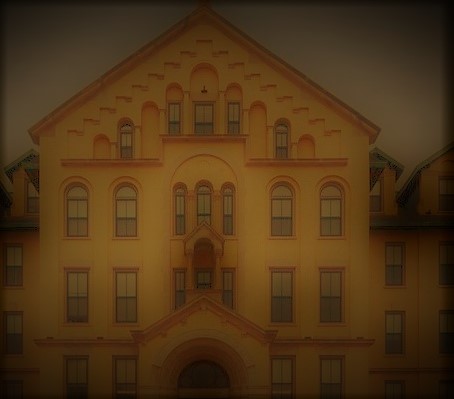
JoAnn walked through a small park and stopped to sit on a bench, where she sipped her coffee, watch dog walkers, and gazed at the crow-stepped gables decorating Crawford House’ roof a block away. Its many tiny windows on the top floor and the austere luster of the old building, intrigued her from an architectural point of view. Six stories high, it dwarfed the nearby buildings, but looked like a stunted sibling when compared to the sky-high apartment complexes closer to the lake.
Kevin appeared, smiling in the sun, shimmering like an apparition. His appearance startled her and she stood abruptly, shut her eyes to the vision, remembering that time he walked up to her happy and alive, arms wide open, grinning and …
She walked a parking lot adjacent to the park. She cut through an alley that brought her to Crawford House’ front door. Bad enough he came into her dreams unbidden. She didn’t need him hovering everywhere she went. She’d loved him. She missed him. She had to move on without him.
The memory of the brief apparition in the park gnawed at her and she found it difficult to concentrate on the morning video calls with her direct reports. Nor did she pay much attention during the practice leaders meeting, a Friday afternoon ritual that capped the week. It used to be fun to attend those in person. Used to be they drank wine, ate cheese and crackers, and treated the meeting like a casual party.
No more. Like anything else in her life, it changed. The Friday afternoon meetings were as dry as her mouth after enduring a restless night of dreams.
Just what did the kid want, crying like that in the hallway? At 4:30AM? And why couldn’t she shake herself loose of the question? If she wanted to answer it, she had to do more than keeping asking herself the same thing over and over again.
She had to do something.
The next morning, she woke at 4, responding to the first of two alarms she’d set on her cell phone. She dressed quickly, finishing just as the second alarm buzzed. She didn’t want to run out of her apartment in a nightgown. Who knew who she’d see? The kid who delivered newspapers? That would give him a real treat: a woman encased in a diaphanous gown.
She laughed as she waited in her baggy sweats, a cup of coffee in her hand. Not as good as the coffee she got from Commuter’s, but it was full of caffeine, so she woke up more and more bit by bit.
Come Sunday morning, she did the same thing. She paced the living room. She stopped at the door, ear pressed to the wood, and listened. Sometime that morning, while she sat on a comfortable leather chair, eyes on the wall-mounted flat screen TV – a giant 80-incher, Kevin insisted on buying, — she dozed.
She took Kevin into her arms and shut her eyes and kissed him, chasing away the images of thin worms and maggots and crooked teeth and empty eye sockets. She remembered him as he’d been.
Then the crying started. She jerked upright and rushed to the apartment door. She pulled it ajar and poked her head out. She peeked both ways. When she heard another cry, she looked at the ceiling and thought the sound came from the floor above.
She hurried to the fire escape stairwell, pushed open the heavy steel door to the staircase, and raced upstairs, her long slender legs taking the concrete steps two at a time.
The child sat in the middle of the corridor, long black hair falling across the front of her face.
“Are you all right?”
Blank eyes, so very dark they looked like black coals, raised slightly, the child’s face lifting just a bit. Dressed in a linen gown, barefoot, her one article of clothing streaked with dirt, the girl said nothing.
JoAnn approached, thinking she should move slowly so she wouldn’t startle the girl. She spoke softly, entreated her to stand. She pulled a tissue from inside the cuff of her heavy sweatshirt and offered it, along with, “Dry your tears. It’s okay.”
“I don’t know where I am.”
“It’s okay. Come with me and I’ll help you.”
The girl shook her head. She pressed the tissue to her eyes, to her nose, opened the tissue and put it against her cheek. JoAnn knelt near her so their eyes would be on the same level. “Why are you in the hallway?”
“Hey! What’re you doing?”
JoAnn looked back over her shoulder at Jack Hansdorf. “I found this kid wandering the hall.” She stood as Hansdorf approached. He looked angry. A bad morning? Too many people asking him about repairs? Kevin liked making them, “pulling his chain” is what Kevin always said with a laugh.
“It’s six in the morning. What’re you doing, wandering the hall?”
“I heard that kid crying. I told you about that. I heard her and I came up here to – to investigate. Maybe we should call the police, maybe we need child protective services.”
“JoAnn.” Hansdorf smiled.
“What?”
“Go back to your apartment?”
JoAnn turned towards the crying little girl, to take her hand and say she’d take the child with her. She’d call the police, take care of things herself.
But there was no one behind her when she turned away from Hansdorf.
“You must’ve been sleeping,” he suggested.
JoAnn’s mouth went dry. She felt tears behind her eyes. “What’re you doing walking around in the halls?” she asked, trying to fight the accusations she saw in Hansdorf’s close-set eyes.
“Guess I’m doing my job,” he answered. “You want to wander around half-dreaming, go right ahead. ” He grinned and walked to the stairwell.
JoAnn turned to look back at the long hallway that stretched the length of the building. There was no trace of the child. But, on the floor, lay a crumbled tissue. Wet, she found when she picked it up. Wet with tears, she imagined.
#
“I found something interesting,” Paula said.
JoAnn put her phone on speaker and placed it on the glass table in front of her. She leaned forward on the leather couch, eyes on all the circular watermarks left by Kevin, because he never used a coaster. Now she added another mark, and she didn’t care.
“You at the office?” Paula asked. “We can meet for lunch and I’ll tell you all – “
“I’m working from home.”
“It’s Thursday. You know that, don’t you?”
“I’m not totally daft,” JoAnn said with a laugh. “Just worn out.” She’d called in yesterday to say she’d work from home. Called in again today. But she didn’t do much work. She couldn’t concentrate on status reports, which had piled up on her laptop
“Are you all right?” Paula asked. “You know, I can work from anywhere. I could come up to Evanston, stay with you for a few days.”
Paula had stayed with her for three weeks after Kevin was killed. It would be nice to have the company.
“No, no,” JoAnn said. “I’m fine.”
After a pause, Paula said, “Well, let me tell you what I found out.” Another pause. JoAnn waited for Paula to continue, imaging her sitting across from her on the hassock. Two girls confiding secrets to one another as they had as college roommates.
“Before your building went condo,” Paula said, “it was a rental property. Before that – “
“I know. A seminary. And before that a girl’s boarding school.”
“Not just a boarding school. It was a girl’s reformatory.”
JoAnn laughed, startled by the image of that old woman – Mrs. whatever – as a juvenile delinquent. “What made you look that up?
“Just curious after you told me about Mrs. Baumgarten.”
“You actually remember her name?”
“I was wondering if she told you the truth, about it being a school, if maybe she was just some senile lady or maybe – “
“Maybe I imagined her?” JoAnn threw in.
“You imagined that little girl in the upstairs hallway, didn’t you?”
“I told you about that?” JoAnn searched her memory.
“Yeah. The other day. JoAnn, you sure you don’t want me coming up to Evanston?”
“A reformatory,” JoAnn whispered.
Paula continued, her breathless delivery making JoAnn picture an exciting glint in her friend’s eyes.
“It was notorious for runaways and the occasional dead girl found in the basement. Some reporter did a piece on the place in the 1940s, but I only found a mention of it, not the article. He died just after it was published in the Gazette. Curious, huh?”
“Caroline,” JoAnn said, only half listening to Paula and suddenly recalling what the old lady had said. Her friend had died. “Okay, I get it. You think the kid I saw is Caroline’s ghost.”
“I think you’re not sleeping well, dreaming of Kevin, getting nightmares because of the way he died, and you need a friend closely.”
“You’re a good friend. Thanks.”
“You could sound a bit more enthusiastic,” Paula rejoined with a laugh. “Just thought you’d enjoy hearing what I found out.”
“Sure. Interesting. Thanks.” JoAnn shut her eyes. Paula was right about her lack of sleep, though it wasn’t only Kevin who crept into her dreams and turned them into nightmares. She didn’t remember the contents of her dreams, just that she had them, and she woke up at four most mornings, then couldn’t get back to sleep. She spent the early AM hours in the kitchen or in the living room, listening for that child and wondering if she’d imagined finding her, sleep walking and hallucinating, perhaps.
“Call me,” Paula said from far away. “Whenever. Remember, I’m up at 4.”
“I know, online with Bangalore.” JoAnn ended the call. She retrieved her laptop from her carryall, the big black bag she dragged when she went into Chicago’s Loop. Sitting on the sofa again, she logged onto the office network and downloaded the latest project summary reports.
She’d forced herself to work, just as she had after Kevin died. She’d banish the old lady and the dead friend and the crying child from her mind.
At least, she’d try.
#
JoAnn came to an abrupt stop when she entered the lobby, a large white paper bag in her hand, the aroma of Thai spices and savory chicken spilling out. An early dinner or a late lunch, she’d told herself when she hurried to a take-out favorite on Dempster Street.
“Mr. Hansdorf doesn’t want you disturbing the tenants,” Sam said with an air of authority,
“I’m only sitting on the bench,” the old woman protested.
“Problem, Sam?” JoAnn intervened.
Standing behind his dark mahogany desk, on a platform that raised him nearly a foot above the parquet floor, the doorman towered over the old woman. “We had complaints. I told you, Mrs. Baumgarten.”
“What kind of complaints?” JoAnn asked, suddenly feeling protective of the old woman. She sidled up next to her. “She’s a harmless senior citizen,” JoAnn said to Sam.
“I don’t care. Doesn’t matter. Hansdorf said she’s not allowed in the building. She doesn’t live here.” He turned to the old woman. “Please, just go.”
“My daughter’s picking me up.”
“She can pick you up outside.”
“She won’t be here for another hour. That’s all I wanted, an hour, to sit.”
“And talk to anybody who comes into the laundry room? That’s where we get the complaints. You scare people, the way you talk.”
“She’s not exactly a threat?” JoAnn said.
“Wait for your daughter outside,” Sam pleaded.
JoAnn looked towards the front windows. Raindrops splattered against the glass. “It’s starting to rain.”
“She can stand under the ledge. She won’t get wet.”
Head bowed, Mrs. Baumgarten walked to the door.
“Come on,” JoAnn said. “You can wait at my place.” She turned to Sam. “When her daughter comes, ring up.”
Sam started to say something. JoAnn waited for him to object. He merely shrugged and she went to Mrs. Baumgarten standing by the large window next to the door. She gently touched her sleeve and whispered, “You’ll wait upstairs with me.”
“What floor?” the old woman asked when they got into the elevator.
“Fourth.”
“Oh, good. My room was on the fourth. I wanted to get to the third, where the good girls were, but I never did.” The old woman suddenly shuddered. “At least I wasn’t sent to the fifth. They were terrible to the girls on the fifth. Just terrible. Some nights….” Her voice drifted off.
At the fourth floor, JoAnn led the way to her apartment. Mrs. Baumgarten stopped at a door marked, “Storeroom.” She glared at the lettering, touched the handle, nodded her small head a few times, and made a barely audible gasp.
“Mrs?” JoAnn asked, searching for the old woman’s name, chiding herself for forgetting it.
“Call me Aunt Ida. I’m Aunt Ida to all the youngsters who come to visit.”
“This is just a storeroom,” JoAnn coaxed. “My apartment’s a few doors down.”
The old woman tried the doorknob. “Poor Caroline. She got locked in for two days.”
JoAnn coaxed Mrs. Baumgarten away from the door, directed her to her apartment, letting the old woman babble on about the past. There was a common room where the elevators stood. One the first floor, where there was now the bank of elevators, there’d been the kitchen and a room where the girls ate. The description the old lady provided conjured a scene from a movie JoAnn once saw, with the kids seated at long wooden tables and adults up front on a dais, a spread of delicacies in front of them while a cook served gruel in cracked porcelain bowls to the emaciated children.
“What happened to Caroline?” JoAnn asked when she and Mrs. Baumgarten – Aunt Ida – sat in the living room, side by side on the leather sofa. “Do you want water or anything? Tea?”
“Is that your supper in the bag? I’m sorry I’m upsetting your mealtime.”
“It’s okay. I’ll eat later. I don’t normally eat this early.” She checked her cell phone for the time. Four-thirty. Way too early for supper.
“We ate at five sharp. Then off to our rooms to study.” Mrs. Baumgarten looked around the living room. “Just doesn’t look the same.”
JoAnn went into the kitchen and dropped her bag of Thai food off on the table. She filled the kettle with water. Aunt Ida would want tea, she decided. No need to ask.
“Poor Caroline,” the old woman sobbed.
JoAnn pulled a tissue from inside her cuff. She shrugged off her leather jacket and tossed it on the chair. Mrs. Baumgarten removed her fur wrap and flimsy cloth coat. She kept her black straw hat on, its narrow brim decorated with fake blue and yellow flowers all around. JoAnn tried to initiate a casual conversation, one that didn’t delve into the past and bring on tears. Where did she live now? How old was she? How many children did she have?
Each question was met with a teary-eyed stare.
“She died. They told me she ran away. Caroline wouldn’t have done that. Not without taking me with her. We had plans. She knew about the closet because she’d been locked in, in the dark, and she felt around the walls, trying to find something to keep her warm because she’d been stripped to her undies. That’s how she found the latch.”
JoAnn bit her lower lip, unsure if she should interrupt what was obviously a painful memory.
“I told Mr. Arnold, the newspaper man, all about it and Miss Eileen walloped me something good because of that.”
JoAnn smiled.
“Believe me, young lady, that was no joke.”
“I’m certain it – “
“You hear an old lady talk and you smile, but living here was no joke. Not with Miss Eileen or any of them, certainly not with Aunt Millie always ready to make you miserable.”
“Your aunt?”
“The head mistress. Aunt Millie. All the teachers were Miss something or other. Talk back and you got the closet. Talk back too much and you got the strap. Be a really bad girl and they put you on the fifth floor.” Mrs. Baumgarten pointed at the ceiling.
“I went up there the other day,” JoAnn said.
“I’m sure it’s different now. My room – this whole place – is different. Eight girls to a room. Four bunk beds, one against each wall. A closet in the middle of the room, with four doors, one for each bunk. Cold water to wash up. Once a week we got to splash in the tubs in the basement. That was fun, so long as Miss Linda or Miss Colleen was there, because they didn’t mind if we laughed and carried on.”
“And the fifth floor?” JoAnn asked.
Mrs. Baumgarten sat silent, like a stone replica of herself. The kettle whistled and she said, “Thank you, dear, I will have some tea.”
JoAnn started to tell her about the child she’d found upstairs. Was it an apparition? Caroline’s ghost roaming the hall? Some kid who’d escaped her grandparents?
“How old were you when you were here?” she asked.
Mrs. Baumgarten sat silent and as still as before, teacup in hand when JoAnn brought in a tray with hot water in a metal pot with a hinged lid, an assortment of teabags spread out on a napkin.
“Eleven when they sent me here. Eighteen when I got out.”
“What did you do to get put in… such a place?”
“Do? I don’t remember. Except my dad said I was a bad kid. That’s after Mom died. Of course, he wasn’t my real dad. My real dad died from the flu when I was just a baby, so I never knew him, my real father.”
“I’m sorry.”
“But that’s enough about me, dear. Tell me all about yourself. You have a lover? Do you work? Are you a typist? A secretary? I bet you have a good job and your parents are very proud. That’s how it is these days. Girls go off to work just like the boys. I wonder how they ever get together to have little ones so there’s a next generation.”
JoAnn laughed. Mrs. Baumgarten joined her, all the tears gone in an instant, the memories of a terrible childhood vanishing back into the woodwork, into the floorboards, the plastered ceiling, and all the nooks, the crannies, of the old building.
The intercom buzzed.
“She’s coming up to get her mother,” Sam said when JoAnn pressed “Connect.”
“I can bring her down.”
“She’s already coming up.”
“Your daughter’s here.”
“Barbara? Here? How did she know I’d be here? She keeps such tabs on me.”
JoAnn let the protest go unremarked. The old lady probably forgot she’d arranged to be picked up. Which made JoAnn wonder how she got to Crawford House in the first place.
“You got her?” The daughter pushed her way into the apartment, her manner as brash as her voice. A heavyset woman, she brushed JoAnn backwards as she entered. “Good. But you didn’t have to bother
“This is my friend JoAnn,” Mrs. Baumgarten said. “Please meet my daughter, Barbara.”
“Catherine. I’m not Barbara. She’s — “ The daughter shook her head and turned to JoAnn. “Okay, thanks for taking care of her. I’m Catherine Hahn.”
“I didn’t want her to wait outside in the rain. Not for an hour.”
“Of course.” Catherine turned on her mother. “You could’ve called me and I would’ve come right away.”
“I didn’t have a dime for the telephone.”
“I gave you that little fold-up phone. That’s what you use to call me. Number one. Speed dial. George and I explained all that to you, Mom.”
JoAnn stayed out of the conversation, amused by the old woman’s foibles, amazed how she described the past so readily, with so many distinct memories, but yet failed to grasp every nuance of the present.
“Do me a favor,” Catherine said as she ushered her mother ahead of her into the hallway. “Leave my mother alone. She’s dredging up memories she shouldn’t be thinking about.”
“I only tried to – “
“Say hello. Say goodbye. Don’t coax her to talk about the past.”
Catherine and her mother walked to the elevator, with Mrs. Baumgarten once more pointing out the locked closet door and wagging a finger at the stairwells at either end of the corridor, relating how one was for going up the stairs and one for going down, and woe to the girl who didn’t obey the rules.
#
“Arnold?” JoAnn let the name roll off her tongue and race through her mind until she remembered the context. “It sounded familiar when she said it,” JoAnn mused, her eyes on the large duffle bag Paula had dropped in the middle of the room. Is she staying the weekend or the week? she wondered.
“The reporter,” Paula said. “For the Gazette.”
“I never even heard of a Chicago Gazette.”
“It didn’t last long. It started up in the 1930s, went bust by 1950.”
“What all did you bring in that?” JoAnn pointed at the army green duffle bag.
“Some clothes, my work stuff. I don’t get the weekend off like some people.” Paula moved languidly across the room, into the narrow kitchen. “Don’t mind me. I’m just helping myself.”
JoAnn didn’t mind. She liked having the company. An old college roommate, Paula had a way of popping up when the popping was needed. She took a backseat to JoAnn’s life when Kevin first came along, then eased back in when marriage loomed. JoAnn never saw Paula as competition. She was complementary.
“I’ll have tea as well,” JoAnn said.
“Got it.”
Dishes rattled. The stovetop clicked-clicked.
“Your locked door mystery sounds intriguing,” Paula said, returning to the sofa with the water on to boil in the kettle. “And a secret latch? What’s that all about?”
JoAnn shrugged. “Probably an old lady’s bad memory.”
Once the kettle whistled, Paula dashed to the kitchen, her long legs taking her quickly across the living room. When she returned with two cups, each with a different herbal teabag, JoAnn put out the coasters and leaned back into the sofa.
“Mint for you, right?”
JoAnn nodded. She saw that Paula had red tea, the type she drank to the exclusion of all others.
“You got to wonder,” Paula said, “if all the store room doors are locked. Maybe they’re not.”
“Why wouldn’t they be?”
“Why would they? What’s hiding behind the door? Mops and brooms?” Paula grinned, her small white teeth contrasting with her dark painted lips.
“I don’t know,” JoAnn said, picturing an adult pushing a child into a small closet. It would be dark in there. Stuffy and hot and scary.
“I want to find out,” Paula said, and jumped to her feet. Seconds later, laughing as they ran from one end of the fourth floor corridor to the other, trying the doors marked “Maintenance” or “Storage” or “No Admittance,” JoAnn felt like a schoolgirl.
They went to the fifth floor. All the closet doors were locked. They ran down the concrete steps at the end of the corridor, swinging on the banister bolted to the yellow wall. The third floor closets were locked as well, and when they started back up the stairs, back to JoAnn’s apartment, they found Jack Hansdorf standing in their way, his thick arms crossed over his chest, bushy eyebrows lowered, and his stare coming at them from two narrow slits in his rough hewn face.
“Just what are you two up to?”
JoAnn gulped, her mouth dry, her legs wobbly.
Paula jumped in with an explanation. “We need to borrow a broom.”
“A broom?”
“My dust buster is busted,” JoAnn said, forcing herself to add a tittering laugh at the end of the sentence. Let him think we’re two harmless girls, two women acting less than their ages.
“These closets are for the maintenance crew, not tenants. Go out and buy a broom if you need one.”
“Fine,” JoAnn said. “Sorry if we – “
“Sometimes you’re a real pain, Miss Matterly.”
“Sorry.”
“Yeah. Sure.” Hansdorf turned away, pushed open the door to the stairwell, and marched off.
“How did he know — ?” JoAnn didn’t finish the thought. She looked at a spot in the corner where the wall met the ceiling, just to the left of the door to the stairs. “I never noticed the cameras before.”
“They’re probably on every floor, at both ends.”
“I never noticed.”
“He must’ve seen us. But why was it so important to confront us like that? Ask yourself that. He could’ve just watched and chuckled to himself and stayed put in his office.”
JoAnn nodded, agreeing. “Maybe he was afraid there’d be one unlocked door and … “
“And we’d find the latch and … Now you got my imagination going.”
They walked back to JoAnn’s apartment, arms around one another’s waist, swaying together like children locked in embrace.
“Know what?” Paula said when they were again sitting on the sofa. “How many spy cameras does that guy have? And what is he spying on?”
“It’s for security. He isn’t spying.”
“How do you know he isn’t looking in on us right now?”
“If he is, he isn’t getting a good show.”
Paula unbuttoned her thin blouse and pulled it open and showed her chest to the walls. “Get a good look there, Hansdorf. A good look.”
JoAnn laughed, succumbing to the effect of her friend’s antics. Just like when they were in college.
“I’m glad you’re here,” JoAnn said.
“Well, I can’t let you solve this locked door mystery on your own.”
“You’ve always been a good friend.”
“Of course,” Paula whispered. “Now, how are we going to find out what else Hansdorf spies on besides the corridors?”
“I don’t know.”
“I do. At least, I know who to call for help.”
JoAnn inclined her head to one side.
“My brother.”
“To do what?”
“Hack the cameras, of course.”
#
Jeremy bounced into the apartment and into Paula’s arms. “You got me up early for a Saturday, sis.”
“My brother,” Paula said to JoAnn. “Little brother.”
“Taller than you.” Jeremy’s smile flashed as bright as his sister’s. A half-head taller than Paula, who towered over JoAnn by a few inches, he had the wiry build of an athlete, with a smooth handsome face that JoAnn immediately liked.
Jeremy set down his backpack. He pulled out a thin laptop computer that he opened on the glass coffee table and slowly sank into the leather sofa’s cushions. He flexed his fingers, rotated his wrist.
“Little warm-up to get started,” he announced.
“You think you can hack the cameras?” JoAnn asked, settling down beside him. She watched the computer screen come to life.
“That your apartment’s router?” he asked, pointing at the first ID in a list that popped up from the bottom. JoAnn nodded. Jeremy opened a white-bordered black window and typed a few commands.
“I promised you coffee,” Paula said from the kitchen.
“And donuts,” Jeremy added, rapidly giving his computer commands that he typed with dizzying alacrity.
JoAnn sat back, crossed her arms over her chest, cupped each elbow, and watched, though she understood nothing about what he was doing. She only knew how to use computer programs, not how to command the machines. Some things about her smart phone were beyond her and she relied on the techs at work to help when she got stuck.
“Must be nice to have a hacker for a brother,” she said when Paula brought over three cups of aromatic coffee on a wooden tray.
“Not a hacker,” Jeremy said. “In spite of what you see me do. Just know a few things.”
“Does this take long?” JoAnn asked.
“Okay, this has to be your building’s router.” He pointed at a plain white screen with blank boxes for a user name and password.
“He’s a genius,” Paula said.
“And whoever set up this router is a doofus, as Dad would say.” Jeremy shook his head. “User name Admin. Password is… Guess what? Wait for it?”
Paula said, “Password. Lower case.”
“We’re in.” Jeremy studied the screen and its list of device names, its obscure menu of actions, and the other data, all of it meaningless to JoAnn.
“How do you get into the cameras?” she asked.
Jeremy didn’t reply. He continued to look at the screen, touching the names in the device list with a finger a thoughtful look on his face.
“I’ll bet these, the IP addresses in sequence, all these numbers there, are cameras. The lowest number…Yep. Got it. That’s the camera controller.”
Another screen popped up. Jeremy enlarged it with a two-finger process on the laptop’s control pad.
“Ever get any emails from the manager?” he asked, turning to JoAnn.
“Probably. Why?”
“We need a user name.” He pointed at the screen. “It’s probably the guy’s email.”
JoAnn found an old email marked “from the manager” on her cell phone. Jeremy typed Hansdorf’s email address into the user name field. He tried “password” for the next field. He tried “admin.” A few more tries of various words and numbers: Crawford House, the street address.
“Well, whoever set up the cameras made some attempt to secure the controller.” Jeremy said, consternation forming on his thin face.
“So you can’t break in?” JoAnn asked.
“Let me try a few things. What’s the password for your apartment’s router? I need to be online.”
JoAnn retrieved a pocket-sized spiral notebook from the bedroom, explaining when she returned, “I can never remember it. It’s sort of automatic when I log on.”
Jeremy merely nodded.
“This going to take long?” Paula asked.
“Just like a customer,” Jeremy said, the comment tinged with a note of irritation. “It takes as long as it takes. If I can’t get around the security… Give me a few minutes. Cool out, Sis.”
JoAnn sat back and stopped watching the meaningless string of words and punctuation marks that Jeremy typed. She paid no attention to the pop-up screens. Paid no attention to the steps he took.
After a while, she wandered into the kitchen and poured herself another cup of coffee from the carafe sitting in the coffee maker. She glanced at the wall clock. Noon. They’d been at this – Jeremy doing all of the work – for the past two-plus hours. Paula had been up at 4 in the morning texting a project leader in India. Now, sitting on a chair facing the couch, she seemed to be asleep, arms at her sides, her head lowered.
“I downloaded a basic camera utility from my website,” Jeremy explained after a half-hour. “Configured it with the IP addresses I think are cameras.”
“Okay,” JoAnn said in a tentative voice. She looked down at the laptop screen displaying ten square windows, five on one row and five on the other. Jeremy clicked on one and enlarged it.
“That seem right? Ten cameras?”
“I guess. I don’t know.” Each of the four floors where residents living had two cameras. Two more were in the lobby. “The basement probably has at least one camera.”
Jeremy switched over to a list of internet addresses, all of them beginning with a 10. “I’ll try these two,” he mumbled.
Now there were twelve small views on the other screen. The two new ones showed the laundry room and the door to the basement storage room where each tenant had a cubby for storing things they didn’t keep in their condos.
“The hallway’s what we want to watch,” JoAnn said.
“Well, this’ll do it,” Jeremy said. “It won’t have the bells and whistles you get if we could get into the control app. You know, signals if there’s movement or anything. You gotta watch all the time. But if you click on a window – “ He tapped the pad below the space bar and the selected view popped up, taking over the entire screen.
“See,” Paula said. “I told you, genius.”
JoAnn hugged Jeremy. “You’ve earned a free lunch. Let’s go out.”
“Can we keep your laptop?” Paula asked.
“For a week or two. I’m gonna need it soon,”
“A week or two,” JoAnn echoed. “That’s all we need.” She paused, looked to Paula for confirmation, saw none in her eyes, and added, “I think.”
#
Sleepy-eyed, JoAnn watched the array of twelve scenes. Each camera was labeled with a number. Jeremy couldn’t say which camera showed which hallway. The lobby and basement cameras were readily identified. For the others, JoAnn sketched a map on a piece of paper while Paula visited each floor, raising her hand, fingers indicating floor number two, then three, four and five.
They congratulated each other for coming up with that scheme. Now, JoAnn made use of it, concentrating on the fifth floor’s view of an empty hallway, taken aback a bit when a newspaper delivery boy – or girl? She couldn’t be certain – dropped off a bundle of papers at the elevator. A few minutes later the same person dashed from the north stairwell, grabbed the bundle by the elevator and quickly dropped off newspapers at apartment doors.
But no little girl roamed the fifth floor. Watching, waiting, only made JoAnn weary. She forced herself not to doze off.
She enlarged one camera view, let it shrink back to its former size, and then pulled up another, skipping around from floor to floor, keeping busy so she wouldn’t go to sleep. From the bedroom, Paula’s loud snoring made her smile. As college roommates they’d complained to one another all the time about snoring and other sleep-time noises.
A shadow moved. Not a shadow. Something dark. Not the newsboy, either. This shadow moved near what JoAnn thought was a storeroom’s door. With the low lighting, the camera’s view wasn’t as crisp as it would be in bright light. JoAnn guessed it didn’t need to be. Jack Hansdorf probably didn’t need detail, so he didn’t keep bright lights on during the night. What did he need from these cameras? A sense of security?
JoAnn enlarged the scene with the moving shadow, pictured it as a person with a black hood over their head, clothing rumpled and dirty and little more than a blanket thrown over their body. It mesmerized her, this moving shadow. She sat transfixed.
Then she rushed into the bedroom. Paula needed to see this.
“Jeeze, Jo,” Paula complained. “I’ve got the morning off. No meetings. Why’re you – “
“You have to see what I saw. Come on. Up. Out of bed.”
Paula slowly swung her legs to one side and sat on the edge of the mattress. She adjusted her nightgown, swept her hair back from the sides of her face.
JoAnn rushed back to the computer in the living room and knelt by the glass coffee table. Paula joined her, yawning and rubbing her eyes.
“Okay, what is it?”
JoAnn sighed loudly. “It’s gone now.” She clicked the enlarged window, noted that it was the camera at the north end of the fifth floor, close to her apartment.
“You hear anything?” Paula asked, and went to the apartment door. She pressed her ear to it. “Something’s out there.”
JoAnn joined her and listened. Shuffling? Footsteps. Her imagination conjuring sound?. She looked through the peephole, saw nothing but the blank wall across from the door, its wood paneling absorbing what little light came down from the fixtures in the ceiling.
“Don’t open it,” Paula warned.
“I don’t see anything.”
Something thumped at the door. JoAnn, startled, straightened her back, jerked her head away from the peephole. Paula stepped back from the door, then further away. She turned and stumbled towards her backpack lying on the floor, next to the low wall separating the kitchen from the rest of the apartment.
“Put that away,” JoAnn hissed when she saw the small handgun Paula had retrieved.
“You saw a shadow. Now we hear a noise out there. I’m not putting this away until – “
“Just don’t shoot anyone. Especially me.”
Paula stood over the laptop. “There’s some kid on the third floor dropping off newspapers.”
“He was here earlier. On this floor.”
“Maybe he came back.”
JoAnn hesitated to open the door, but the camera didn’t show anyone or anything in the hall. She saw nothing through the peephole, either. There’d been that thump sound, but… ?
She turned the deadbolt and opened the door a crack. She peered into the hallway, afraid there’d be someone to one side, out of camera view.
A newspaper wrapped with a red ribbon lay on the carpet, a three-by-five card attached.
“Compliments of The Tribune,” the card read.
“The newspaper,” JoAnn said. “Complimentary.” Now she understood why the newspaper delivery boy – girl? – had come back. First, deliver the papers to subscribers, then bring up bundles of complimentary papers and distribute them. Why not carry both at the same time? Too complicated? Might get subscriber copies mixed up with the gifts?
“The Sunday paper?” Paula said. JoAnn nodded and Paula grabbed the thick newspaper from her. “Haven’t read the comics in years.”
JoAnn sighed and wandered across the living room to the sofa, where she sat, elbows on her knees, chin in her hands. Something shut slowly on the screen for the fifth floor north’s camera. She guessed some resident had retrieved their morning paper.
She glanced at the time at the bottom of the computer’s screen. Not quite five in the morning.
“Get some sleep,” Paula offered. “I’m wide awake. You’re tired.”
More than tired. Frightened because of the shadow she’d seen. Confused because she didn’t see it again. Irritated because this entire thing took up too much of her life, pushing out everything else, including the dreams she’d been having about Kevin.
#
Paula’s 12-year-old Corolla cruised north on Route 41 and JoAnn watched the passing scenery, the strip malls, trucker restaurants, gas station after gas station, and residential neighborhoods obscured by patches of forest. Taking Monday afternoon off from work and going up to Easton College sounded like a good idea when Paula proposed it. Now, JoAnn wondered if it was a waste of time. Paula wanted to view the microfilm of the Chicago Gazette, a newspaper that lived for a mere 30 years, its heyday corresponding to the Great Depression and the Second World War.
Daydreaming, JoAnn watched Kevin memories vie with that shadow-like thing she’d seen early Sunday morning, the two squaring off for combat in her imagination. She still shuddered when thinking about that scary thump on the floor outside her apartment door. She still shivered when she let a mental picture of the indefinable dark form moving on all fours become clearer, morphing into a red-eyed monster of a man.
She shook herself free of the daydreams.
“Almost there,” Paula said as she maneuvered off the main road and onto Deer Path Avenue. A downtown area flowed past them, but soon they were clear of the shops and buildings, the small hotels and the even smaller shopping center. Trees graced each side of the street. Rolling green lawns undulated across small hills and gentle rises.
Easton College appeared suddenly, its grounds protected by a tall wrought iron fence. The main gate stood open, inviting visitors in spite of the forbidding ironwork.
A liberal arts college, Easton catered to a small student population. JoAnn noted two dormitory buildings, both three stories high, separated by a wide quad. She didn’t see any students lounging on the steps of either dorm. They didn’t stroll on the cement pathways or lay on the grass, either.
“This place still open?” she asked.
Paula pulled into a parking lot full of sports cars and SUVs. Her lone Corolla looked out of place. “I called. The library’s open.”
“Where are all the students?”
“What do you think, dear? In class.”
“All at the same time?”
Paula swung herself out of the driver’s seat and headed up a walkway to a squat two-story structure with a set of granite steps spanning the front and leading to a portico with six smooth marble columns that added to the austerity.
Inside, the library, as empty as the lawns and walkways outside, urged hushed whispers, the dark paneling on the walls and the shiny dark wood of the desk facing the entrance warning JoAnn to speak as softly as possible.
A portly woman with a large shell necklace exited an office. She smiled like someone delighted to receive a visitor. “And you must be the Paula Grayson who called this morning.”
“Yes. Sorry, but we couldn’t get here until this afternoon. We can still – “
“Delighted to have you come this far. We’re open until nine tonight. The students crowd the place after four, but – “ and she laughed – “no one’s used the microfilm room in quite some time. Not with everything on the internet like it is.”
“My friend.” Paula pulled JoAnn over by her sleeve, and introduced her.
“Dolores,” the librarian said. She pushed open a waist-high door. “This way.”
The enclosed room she took them to was small, with a window high up in the wall that looked out on section of the grounds. Two microfilm machines sat side-by-side. The librarian rifled through a tall metal cabinet in the corner of the room, then set down a large cardboard box marked “Gazette, 1930 -1947.”
“The paper started off in 1925,” Dolores said in an apologetic tone, “but the library didn’t start collecting them until 1930. And then only because the paper’s owner was an Easton graduate. In fact, many of those involved with the paper were alumni.”
Paula nodded, rubbed her hands together, took the box from the librarian and set it on a table against the wall.
“Just come out to get me when you’re done. I’ll make sure everything’s all neat and tidy, put the box away, and you can leave. I like checking up on things.”
“Thanks,” Paula said. Then, once the librarian left, she turned to JoAnn with a smile. “Probably wants to make sure we don’t scarf up one of the reels.”
“She didn’t sound suspicious of anything.”
“I guess I hear stuff different than you.” Paula pulled out a chair in front of one of the machines. She turned back to the table, tilted up the box of microfilm reels, and pulled out one marked “Jan 1940 – Jun 1940.”
“That when Arnold’s piece appeared?” The other chair scraped the floor, squealing when JoAnn moved it. She sat and peered at the empty back-lit glass screen while Paula threaded the 35mm microfilm across the rollers.
“It’d be easier if we had an index, like they do with the New York Times,” Paula said.
“Easier still if they digitized all this so we didn’t have to make a road trip.”
“Aren’t you having fun?”
“I blew off a meeting with my most troublesome project team, so now I’ve got another thing to worry about.”
Paula shrugged and pressed a button to make the microfilm roll to Page One, January First.
“I doubt some goings on at a girl’s school is page one news,” JoAnn said.
“Sit back. Enjoy the journey.”
They traveled past Joseph Stalin’s birthday in January, which warranted front page space, onto news about Finland and the possibility of it defending itself against the USSR, with February bringing on war between the two. Soon, Germany hit southern Europe. Past fighting in Norway, the taking of Belgium and Denmark, the fighting in France, all the way to Dunkirk. All of it front page news, and all of which Paula merely skimmed.
The screen, its occasional loose hairs marring the view, and dust accumulating at the edges, blurred at times, forcing Paula to turn the focus knobs to make things sharper.
“You sound annoyed,” Paula said after JoAnn sighed louder than usual.
“Slow down. We may’ve missed something.”
“There’s a local section. Metro. If it’s anywhere, it’s there.”
“I didn’t see any – “
“That last section. June. I noticed it, but it wasn’t in the previous months, so it must’ve been new.”
JoAnn sat back. Waited. Wondering if this was worth all the effort. If any of this was worth what effort she’d made so far. For all she knew, the entire thing was a product of her nightmares. But didn’t she see a little girl? Didn’t she speak to the child? A kid who’d gotten out of the apartment she’d been visiting and who probably scampered off, afraid of getting caught by her grandparents.
“There he is,” Paula announced, stopping on the Metro section from a day in August. “Bernard Arnold.”
“That’s not about Crawford House. What is that? Some report on a robbery?”
Paula kept going. Arnold didn’t have an article on the Metro lead-in page every day, but his name appeared inside the paper most days, all of the articles about some minor crime, one regarding smuggling, another on a black market thriving near L:aSalle Street Station.
But the piece on Crawford House came on Metro Page One, a photo of the school emblazoned across three columns, with Arnold’s article underneath. Labeled part one, the article proved to be the only piece published. The reporter was killed by a stray bullet during a gun battle between the police and a Chicago-based gang, a story the paper reported the next day.
“Doesn’t tell us as much as I thought it would,” Paula said, lips scrunched together. She rewound back to the page with the Crawford House photograph. JoAnn peered from the side and tried to read the fuzzy words.
Paula read out loud, but in a whisper. Crawford Reformatory for Girls had a reputation for runaways, Arnold wrote. It also had an inordinate number of inmate deaths, many of them reported as suicide. Punishment was severe for even minor infractions. The head mistress boasted that the school’s job was to reform and educate, not coddle young criminals who might go on to birth more criminals in the future.
As to the mystery of a strange creature living in a basement …
“Wait a second,” JoAnn said, stopping Paula from reading further, grabbing at her upper arm and pinching her slightly through the thin fabric of her sleeve. “Where did ‘creature’ come into all this?”
“That’s why I wanted to read the article for myself. That book I mentioned before? It alluded to some mystery about the place, mentioned this article and Bernard Arnold.”
“It says… am I getting this right?” JoAnn squinted to bring the screen into focus from where she looked sideways at it. “Part two continues the strange tale.”
“And part two never got published.” Paula paused. “Because Arnold was killed.”
“Do you think he was killed to stop him from publishing?”
Paula gave Joan a blank look. “We don’t know anything more than we did.” She shrugged, loaded another reel, scanned to Metro, and perused it page by page, a finger tip on the screen helping her read the articles.
“A little obit on Arnold,” she said, tapping a small one-column piece beneath the fold. “Nothing about the rest of the story.”
JoAnn sat back, exhausted. Did it matter that Arnold was killed to protect the secret of Crawford House? If so, it deepened the mystery that much further.
“I guess we’re done.” Paula said. “You want to keep checking?”
“For what? If the paper never published the rest, then what’s the use? So there were rumors of some man living in the school? What, a janitor? Some guy shoveling coal into the furnace? Girls with active imaginations telling stories to one another, to scare each other?”
JoAnn stood. Something nagged at the back of her mind. She imagined that reporter running to get away from … “We’re done. Come on. Time to go home.” She checked her cell phone. “At least we’ll miss rush hour. Most of it.”
Paula went to get the librarian, who checked the boxes of microfilm, lifting each of them and hefting them in the palm of her hand, one box at a time, nodding each time to show her satisfaction.
“You’d be surprised how often these reels are taken,” she said.
“I guess,” JoAnn offered.
“But nobody’s made much use of these machines lately, I have to admit. The kids – the students – all use their computers and don’t bother with these little newspapers nobody even remembers.”
JoAnn nodded, suddenly weary.
“Actually, in the time I’ve been with the library, there’s been only one other person who’s looked at the Gazette.”
Paula perked up. “Yeah? Who was that? Were they interested in the Crawford Reformatory?”
“Yes. That sounds familiar. It was Miss Arnold. Helen Arnold. I remember her because she was older than me and a sweet thing who liked to talk. Her father was a reporter.”
“Bernard Arnold,” JoAnn said, more interested now than she’d been moments before. “Do you know how we can reach her?”
“She died a few years ago.”
JoAnn lowered her eyes.
“But she has a daughter. Had. Sandra. I don’t remember the last name, but I think she – Helen, that is – gave money to some historical society in Highland Park. And donated her father’s papers.”
Paula turned to JoAnn. “Play hooky tomorrow?”
#
They parked at a public lot a block from The North Shore Museum and Library. Another day of, as Paula put it, “playing hooky,” JoAnn mused. Two afternoons in a row now, that she’d put work aside to pursue this chase. Paula was awake at four in the morning and finished with her day’s work by noon, but JoAnn slept late and had time only to send an apologetic email to her boss, claiming illness as a reason for not coming into the office, implying that she wouldn’t be available by phone, either. A similar missive went out to her direct reports.
“Don’t worry,” Paula said as they stood behind her car. “You won’t get fired for being sick.”
“I just hope this isn’t some sort of wild goose chase. Just what do you – “
“Think we’ll find?” Paula finished the question for her. “It completes the circle, dear.” She threw an arm across JoAnn’s shoulders. The touch felt warm and reassuring. JoAnn hadn’t worn a jacket and her thin white blouse let in the chill of a March wind that had come up suddenly.
The museum smelled of pine, the eggshell-white walls covered with photographs of life on Chicago’s North Shore, that section of land bordering Lake Michigan starting at about 10 miles north of the city’s downtown. The photographs were arranged like a student’s timeline for social studies class, with a thick black strip of tape running the length of the wall and hash marks noting the dates.
Another wall held poster-sized blowups of Chicago newspapers from 1890 through to the present, the headlines announcing great events, like the burning of the Hindenburg, the assault on Pearl Harbor, the end of World War Two, and the attack on 9/11.
Paula gravitated to a poster of The Chicago Gazette from its premier issue, a Friday in early October 1929, before the crash that precipitated the Great Depression.
A tall young man in a narrow black tie centered down his starched white shirt appeared, like a strange apparition coming to life right up out of the floor. JoAnn, startled, took a step backwards. Her eyes went to the youngster’s crepe soled shoes.
“There’s a five dollar entry fee,” he said.
“I got it.” Paula was quick with a ten.
“We’re open until four.”
JoAnn glanced at her cell phone. They had three hours. “We want to view the Arnold collection.” The museum’s web site listed that collection as one of their holdings.
With a nod, the boy with the skinny black tie opened a gate in the counter that surrounded a small reception area marked “Employees Only.” He took long legged strides to a desk at the far end and soon returned with a three-by-five card in his hand.
“That’s in the library,” he said. “You need written permission from the Arnold family if you want to see the contents. If you just want to look at the public collection – “
“Contents of what?” Paula asked.
“We have the Arnold papers. The public collection, as I started to explain, is in the museum.”
JoAnn looked to Paula. Now what?
“Okay,” Paula said. “How do we get written permission to view – “
“To see the contents? Well, you need to call or write the Arnold family. There’s a granddaughter here in Highland Park. I have her address.”
“Telephone number?”
“That, too.”
JoAnn pulled her cell phone from her backpack.
“No cell phone usage in the museum or library, miss. And you need to check your backpacks.”
Paula’s face said, “Rules. I hate rules.” JoAnn just sighed, took a slip of paper from the black tie boy and went outside to call Beverly Arnold, Bernard Arnold’s granddaughter.
“Yeah,” Beverly said when JoAnn explained – lied – that she was a student doing a paper on The Gazette, “my auntie, Aunt Helen, donated a lot of my grandfather’s stuff to the museum. Don’t know why.”
“Can I get a written – “
“No one’s ever wanted to look at that box before,” Beverly said. “I’ll call Carl. He’s the kid on duty, right?”
“He didn’t give his name.”
Beverly described Carl.
JoAnn said, “That’s him. But he said permission has to be in writing.”
“I’ll call him. Look, I’ve got a little shop on Central. If he won’t do it with just a phone call, come on by. Bev’s Bees and These. Near Second Avenue. But let me just call Carl, so you don’t have to make the trip.”
“Thanks. Appreciate it.”
Paula stood with a pointed look of anticipation, her impatience painted boldly across her face.
“She’s going to call. Verbal permission. Otherwise we’re off to Central Street.”
“That’s just a couple of blocks…” Paula looked around, pointed south, towards the cluster of restaurants and stores of downtown Highland Park. “That way.”
When they went back inside the museum, Carl greeted them with a frown. “I don’t like breaking the rules,” he said. “But Miss Arnold gave me the okay.”
That said, he ushered Paula and JoAnn into a small room with a chair and a desk. Carl disappeared for several minutes, then returned pushing a metal cart – squeaky wheels disturbing the austere atmosphere – loaded with two cardboard file boxes and a folding chair placed across the top.
“Like I said,” he announced in whisper, “we close at four.”
“We’ll hurry. Or we’ll come back tomorrow,” Paula said.
“If you want, but there’ll be another five dollar charge for each of you.”
JoAnn’s laugh came out as a snicker. She gave Carl an immediate apology and a smile.
“Of course,” he mumbled, and stepped backwards out of the room, shutting the door as he went, with “for your privacy” as a final remark.
Paula dug into the first box and pushed the cart out of the way. It took up a good third of the room.
“Mementos,” JoAnn said, sorting through the box, pulling out plaques and framed certificates, things that denoted the man’s life, none of them of major importance outside the Arnold family. She imagined the man’s son putting these things in a box, storing the box in the attic, leaving the box for his Aunt Helen to find and cherish because the contents defined a sibling’s short life.
An obituary stated that Bernard died at age 34, leaving behind a wife, Lucille, and twin ten-year-old boys.
The second box had the treasure JoAnn and Paula were looking to find.
#
The blurry page on the cell phone screen made JoAnn think she should’ve taken notes when they read Arnold’s old typewritten single spaced manuscript, which comprised parts two and three of his exposè on the girl’s reformatory.
“I can make it out,” Paula said. She and JoAnn sat crossed-legged on the living room rug. JoAnn had a spiral notebook on her lap, pen in her hand, determined to transcribe what they’d learned by reading the original manuscript.
“I work better with an outline on paper,” JoAnn said.
“I remember a lot of what we read, so the blurry screen – “
“Do you think it’s real?” JoAnn interrupted.
“So real he got himself killed the day after part one came out.”
According to the unpublished article, the infamous Crawford Reformatory for Girls, was known for missing kids and several suicides. That’s what the published piece claimed. The second and third installments, never published anywhere and kept by Helen Arnold, the reporter’s sister, provided a fantastic explanation based on hearsay, innuendo, gossip, and the fears expressed by several of the girls Arnold interviewed.
A strange man inhabited the basement. He roamed at night. Some girls saw him. One eight- year-old, deemed incorrigible by her parents and sent to the reformatory, disappeared after being locked in a storage closet for three days. Another was found dead in the basement washroom. Over the years, girls came and went, most discharged or, if convicted of a crime as teens, sent to an adult prison once they turned 18. These older inmates told even more fanciful tales.
“Know what’s weird here?” Paula said, tapping the blurry cell phone screen as she swiped from page to page. “The superintendent that Arnold interviewed. He denied all these allegations. Actually laughed about them.”
“An interesting coincidence that his name was Hansdorf.”
“Same as your Jack Hansdorf the building manager. If we dug deeper about the building’s history I bet there was a Hansdorf involved somehow right from the very beginning.”
JoAnn made a numbered list: reform school for girls; seminary; rental apartment building; turned condo.
Next to each she put the Hansdorf name they’d discovered. She didn’t know what Hansdorf had to do with the seminary, but she remembered Jack Hansdorf once mentioning his father managed Crawford House when it was all rentals.
“Find out the names of all the condo owners,” Paula said, “and I bet a large block of units is owned by the family.”
“Hansdorf family?”
“That makes a nice fit.”
“Just one thing, Paula.” JoAnn let the thought she had stay a moment more in her mind before letting it loose. “The school was built back in 1880. Let’s say this guy roaming around at night started up in the 1920s.”
“That matches what one of them – the kid who left the school and became a functional citizen according to Arnold – said in her interview.”
“How old would he be now? That was over a hundred years ago.”
Paula shrugged.
“This whole thing could just be the kids’ imagination,” JoAnn continued. “Stories they told to scare each other.”
“Baumgarten,” Paula blurted out.
“The old lady I told you about?”
“We should ask her what she remembers. Tell her about the manuscript.”
JoAnn thought over the idea. The old woman could be half senile, though. And unless she came back to Crawford House and Sam or whoever was at the reception desk to let her go down to the basement, there was little chance of finding where she lived.
“Sam talks to her all the time,” JoAnn said. “Maybe he knows more about her.”
JoAnn didn’t learn much from him, other than he’d told the old woman not to come by in the afternoons while Hansdorf was in his office.
“I felt bad,” Sam admitted. “That time I made her wait up at your place. Jack’s funny about the basement.”
JoAnn’s interest perked up. “What about the basement?”
“He just gets riled up about it. Nervous, if I ask him about anything, like why there’s a storage room down there that nobody uses. Max, the janitor, has to go up to the first floor broom closet if he needs a mop or something. Why can’t we keep stuff in the basement?”
“Hansdorf probably has his reasons,” JoAnn offered, though she wondered the same thing. How much credence did that lend to Bernard Arnold’s strange article?
“I’ll let you know if Mrs. Baumgarten comes back.”
“You don’t know where she lives?”
Sam shook his head. JoAnn thanked him and started to the elevator. He called out, “I think she’s at an assisted living place in Skokie. Gets someone to call her an Uber when she comes here. I’ve called one to take her back.”
“That helps. What facility?” JoAnn asked as she hurried back to Sam’s desk.
He shrugged. “It’s been a while since I called a ride for her. Her daughter’s been picking her up.”
When JoAnn returned to her apartment and told Paula what she’d learned, the reaction she got was a typical one for her friend. “How many of those places can there be in Skokie?”
“If it is Skokie.”
“We could call all over the North Shore, dear. We’re bound to find her.”
But the facilities they called, gleaning their location and phone numbers from a map search on their cell phones, refused to disclose if a Baumgarten was a tenant, citing privacy rules and residential policy.
Dead end, JoAnn thought. “I’ll just wait until she shows up.”
“I have a better idea.”
Paula outlined what had flashed across her mind, hands rustling the air, her eyes blazing, animated like she’d been when they were college roommates. JoAnn could go to each of the seven assisted living facilities they identified. She’d be a – as Paula put it – “a cousin twice removed and from out of town.” Wants to visit her relative since she’s passing through Chicago. Oh? Not a resident? Sorry. I must’ve gotten the name mixed up.
“And you think I’ll get a hit? And why me? Why not you?”
Paula laughed. “Me? You think they’ll believe I’m a distant relative?”
JoAnn laughed with her and they held hands sitting across from one another on the floor, rocking to and fro, like children.
After making a list of the places to try, arranging them in sequence based on the map view, they left on what JoAnn feared might be a fruitless mission. She didn’t say so to Paula, and chided herself for not being more positive.
They found Ida Baumgarten at the third place they visited, with each visit, including the third, garnering odd looks from the caregiver on duty at the main desk.
“Don’t let it bother you,” Paula said when JoAnn complained as they got back into the car after the first visit. She made the same remark the second time, but on the third visit she merely smiled, and they booth took the visitor’s paper badge given to them and hurried to Baumgarten’s room at the end of the first floor residential corridor.
They found old woman sitting on the edge of her bed, a TV tray in front of her with a single cardboard plate of crusty food.
“You’re not Mrs. Baumgarten,” JoAnn said.
“Not the one you expected? It’s a common name.”
“Common name,” JoAnn said, and looked at Paula.
“You seem like a nice couple,” the wrong Mrs. Baumgarten said, and turned her attention back to her meal.
Outside, in the parking lot, Paula warned JoAnn not to give up hope. They had more places to try. But none of them produced the result they wanted and JoAnn suspected Sam didn’t know as much as they’d expected.
They stood by the car, JoAnn a bit forlorn, Paula tense and thoughtful.
A uniformed guard, his leather jacket open, bounced down the few short steps in front of the assisted living complex’ glass doors, a cloth hat with a shiny patent leather visor set at a jaunty angle on his head.
“You ladies asking about Mrs. Baumgarten?”
Paula nodded.
The guard gave them a broad smile, white teeth flashing, dark eyes taking in Paula, especially. “Hope she’s fairing okay. She moved out a couple of months ago. Went to live with a daughter. That’s what she told me, anyway.”
“Daughter,” JoAnn murmured.
“Nothing happen to the lady, did it?”
Paula shook her head and offered the cover story she’d concocted for JoAnn, adding, “I’m just a friend helping her get around.”
“Come around again sometime. I’m Nick.” The guard offered his hand. Paula looked at it for a few seconds before taking it. Then Nick walked quickly across the narrow parking lot to a bus stop’s steel and glass shelter.
“Do you remember the daughter’s name?” Paula asked.
JoAnn didn’t.
“Back to square one then.”
#
JoAnn dragged herself out of bed and into the kitchen. An animated Paula sat at the small dining table set against the wall separating the kitchen from the living room, headphones on her ears, mike by her mouth, her coffee cup on the protruding counter set across the cut-out in the wall. Usually eating alone, JoAnn took her meals sitting on a stool in the kitchen, at the cut-out, watching the big screen TV mounted on the living room wall.
With lipstick on her thin lips, a white shirt with a ruffled front, Paula looked ready for a day’s work. JoAnn smiled. Her friend was near-naked from the waist down, but the camera in her laptop didn’t show that. To whomever she spoke with, she was the smartly dressed project manager, ticking off problems to be addressed, issues that had been resolved, and plans for the near future.
JoAnn poured herself coffee. She gulped it down, enjoying the warmth it spread through her chest, the way the caffeine instantly refreshed her. She’d awakened expecting she’d have an easy Friday, with only a morning practice leader’s meeting and then nothing to do afterwards except devote herself to – what? To her personal pursuit?
Then she realized, today’s only Thursday. Checking her cell phone’s calendar, she grimaced at the piled up meetings she’d scheduled, the list of reports she’d need to write and submit to the Cruncher, the nickname for the company’s document repository.
“Well,” Paula said, slapping her hands together. “That went well.” She pulled off her earphones.
“Bangalore?”
“Where else at 430 in the morning?” Paula unbuttoned her shirt.
“Make sure your camera’s not still on.”
Paula shut her laptop. “Our little girl was at it again.”
“What?” JoAnn climbed onto the stool in the kitchen and leaned on the cut-out’s counter. “Why didn’t you come get me?”
“I tried. You wouldn’t wake up. Don’t you remember?”
JoAnn shook her head. She didn’t think she’d slept so soundly.
“When I got back,” Paula said, “she was gone.”
“You saw her?”
“I saw something.” Paula pointed at the laptop with the camera display. “When I couldn’t get you up I came back into the living room. The storage closet’s door was closing. I think. Hard to make out details. Light’s too low.”
JoAnn slipped off the stool. At the couch, she sat and looked at the laptop’s screen. Jack Hansdorf entered the picture. She quickly checked the paper map she’d made. The screen with Hansdorf in it was fifth floor north. Waving her hand, she called to Paula, who ran over, nearly tripping on her backpack still on the floor.
“It’s five AM,” Paula said, dropping onto the sofa. JoAnn checked the time at the bottom of the screen.
Hansdorf opened the storage room door.
“He didn’t use a key,” Paula said.
JoAnn, mouth slightly open, nodded a few times. The door was unlocked. Odd. When she and Paula checked the storage room doors a few days ago they were all locked tight.
A few minutes passed.
“What’s he doing in that room?” Paula asked. “I mean, all this time.”
“I’m going to find out.” JoAnn slipped off her nightgown and padded into the bedroom, pulled on a sweatshirt and sweatpants, put slip-ons on her feet, and started for the apartment door.
“He’s still in there,” Paula said. “But he could come out any second now. He’ll see you if you’re in the hallway.”
JoAnn grinned. She pulled a bottle of Kevin’s whiskey from the top shelf of the kitchen cupboard above the counter next to the sink. “Rot gut,” she remarked, and splashed her face with it, rubbed it into her hair, and then rinsed her mouth with a small amount that she spat into the sink.
“Guess I’m just a drunk come home and on the wrong floor,” she said.
“He’ll buy that.”
Upstairs on the fifth floor, JoAnn walked quickly to the storage room where Hansdorf had disappeared. The door stood ajar. She opened it wider and peeked in.
No light, but she didn’t need much more than what filtered in from the hallway. Brooms, mops, buckets, cleaning supplies on a shelf. All the usual contents she expected she’d find. But no Hansdorf. He didn’t stand in the closet inspecting anything, tallying anything, doing anything that a building super might find necessary.
A steel cabinet, nearly as tall as JoAnn, was pulled away from the wall. She looked behind it, at a half-height open door. On her knees, she squeezed between the cabinet and the doorway. Plenty of room. She was a small and slightly built woman, so she easily fit into the narrow space. Hansdorf, a much bigger person, must’ve struggled to get in there.
But the cabinet moved. Easily. With barely a nudge from her. Wheels? Small rubbery wheels that made moving the storage unit as easy as opening a sliding door?
“All this time and you still don’t understand what I’m telling you?” Hansdorf grumbled from below.
JoAnn peeked into the doorway. She crawled forward for a better view. A staircase spiraled to the right, then left, flowing like a waterfall into a dimly lit basement room. She hesitated only a moment before venturing a few steps down, where a fetid odor rose into her nose, causing her to open her mouth to breathe.
“This you understand, don’t you?”
A child’s yelp of pain, followed by a dismal cry, hurtled up from below.
“Don’t hurt the pretty. She’s my pretty.”
“Be careful next time when you let her out,” Hansdorf said. “Now you get going. I got to muck out your cell.”
“Don’t hurt the pretty.”
“You do what I say and I won’t hurt her.”
JoAnn froze in place, her ears burning. Whoever kept pleading “Don’t hurt the pretty” sounded like a child one moment, a soft-spoken man the next. Soft wheezing sounds accompanied the words. Harsh guttural sounds trailed along behind the plea.
She narrowed her eyes and peered into the dimly lit room beneath her. The wooden banister along the rickety stairs vibrated slightly, then suddenly shook when a large gnarled hand moved into view, the fingers wrapped tightly around the wood.
Two large eyes astride a thick flat nose hovered at the base of the stairs. JoAnn wanted to back up. Her feet begged to move, but she didn’t. Gray searching eyes, red where a black pupil should have been, arrested her, threatening for a moment to pull her in.
Now was not the time to scream. JoAnn fought the urge. The face on the stair grimaced. The mouth opened. Didn’t he – it – see her? She moved back a step, cringing when the stair creaked, when her sweaty hand slipped on the banister.
“Don’t hurt the pretty.”
JoAnn sucked in a breath. The face came closer. Not so close that she could touch it, or so close that she could smell its breath. Not as close as her fear put it, but close. The thing with the red pupils pulled itself along, gripping the banister and making it shake.
Now, JoAnn told herself, is the time to run away. That’s the smart thing. The brave thing would be to confront Jack Hansdorf about the prisoner in the basement
She backed up. She looked over her shoulder and realized she’d strayed far from the fifth floor, twisting when the stairs twisted. She walked backwards, eyes on the strange figure below her, listening to him – it – grunt with each effort to climb the spiral staircase.
She turned and hurried away, the palms of her hands scrapping the stairs as she used all four limbs to propel herself along. The man – the prisoner – hadn’t seen her. If it had, it must’ve registered her presence as meaningless. She wasn’t a threat, though she wondered what was meant by, “Don’t hurt the pretty.”
Jack Hansdorf hadn’t seen her. He didn’t chase after her. When she reached the top of the stairway, she got down on her hands and knees to wiggle through the small waist-high door in the wall.
Standing, she backed up. The stairs to the basement continued to creak, the banister groaned again and again. The cabinet on wheels moved a bit and JoAnn turned away, stumbled into the hallway, and fled to the north stairwell. She raced downstairs to the fourth floor and the safety of her apartment, away from the grumbling beast she’d heard panting and wheezing as it climbed the rickety staircase.
Paula stood by the glass coffee table. “What happened? I never saw you move so fast.”
“We’ve got to call someone. The police. Hansdorf’s got something down in the basement. And that kid? The kid’s down there as well. She had to be.” Don’t hurt the pretty, the strange man had said. That had to refer to the child.
“You saw her?”
JoAnn shook her head. “But I know she’s there. I saw that thing. I don’t know if it’s a man or what, but I saw it.” She remembered the wide gray eyes, how they looked up at her from between the steps spiraling down from the fifth floor, all the way down, down into the depths of the building. Eyes that failed to see her. Maybe, she reasoned, it navigated only by its sense of feel. Maybe its eyesight failed at any distance whatsoever.
“I’ll call right now,” JoAnn said.
“Calm down,” Paula urged.
Head nodding, JoAnn calmed herself, but her hands shook when she took out her cell phone. Her eyes watered. Her knees quivered. She couldn’t stop herself from seeing and re-seeing those large gray eyes, that flat nose and wide pock-marked face.
“I had to see it,” she whispered, half to herself and partly to Paula. “I didn’t imagine it. There was enough light. I went down a full flight of stairs. Maybe I went two. I saw what I saw.”
“Dear, I believe you. But I don’t know if the cops will.”
“We’ll find out.”
Paula snatched the cell phone from JoAnn’s hand. “And if they don’t? Hansdorf’ll know that you know. Is that smart?”
JoAnn fought back her tears. “I can’t let that thing just… I can’t let that kid down there stay where she is?”
“We need a better plan. You call the police, they’ll think you’re nuts. Or drunk, if they take a whiff of you.”
“I’ll clean up, change my clothes.”
“If they just come over, they’ll just look around the basement and – “
“I’ll tell them about the fifth floor.”
“Right, the hidden door. The spiral staircase. Sounds sort of fantastic. Why would there’d be a staircase all the way from the fifth floor to the basement?”
“I don’t know.”
“I don’t think they’ll believe you, dear.”
JoAnn felt a tear on her cheek. Paula embraced her. They both trembled. JoAnn broke free and glanced at the camera scenes on the laptop’s screen. “I need to take a picture of what’s down there.”
#
Though she didn’t mean to, JoAnn slept on the sofa for much of the morning, missing a scheduled video call with her boss, a one-on-one to discuss her progress as a practice leader. Not good, she berated herself, and sent off an email feigning illness. She imagined her superior, a VP who’d been with the consulting firm for more than twenty years, shaking his head and not liking what he read. Harry Treet didn’t believe in giving anyone a break, she’d been told years ago.
“Anything?” Paula asked, bringing over two cups of coffee.
“Why’d you let me sleep? I’ve got reports due. I missed a really important meeting. I missed some less important ones, as well. I mean, I have a job. I can’t just push all that aside and chase down this.. .this thing that’s going on.”
“Sorry,” Paula said, put a cup of coffee on the glass tabletop and glided to the dining table and her own computer.
“Don’t mean to sound mad.”
“You’re right, dear. We both have jobs. I just thought you needed some sleep after what happened.”
JoAnn sniffed her sleeve. She reeked of Kevin’s rotgut whiskey that he drank on rare occasions. She heard him laugh when she complained about its smell.
“There’s nothing we can do right now,” Paula said. “Take a shower. You’ll feel better.”
“And not be so nasty?” JoAnn said with a smile. “Thanks for being here.”
“Of course.”
Later, in the afternoon, after JoAnn dashed off two of the reports she had due and had gotten a reply email from Treet that didn’t sound as harsh as she feared, offering to reschedule the one-on-one, the stress she’d felt earlier lessened. She knew she could juggle everything on her plate, from handling work to rescuing the child in the basement, to dealing with whatever man or whatever Hansdorf imprisoned down there.
“Tomorrow morning,” she said, “we need to take turns watching for Hansdorf.” She pointed at the array of camera scenes. “See if he’s got some way into the basement. Why come all the way up to the fifth floor and then go down? That doesn’t make sense, does it?”
Paula shrugged. “Not to me.”
JoAnn stared at the screen and watched an elderly couple walk slowly along the third floor, disappearing from view at one point, then picked up by the camera at the opposite end of the corridor. Were they out for a stroll in the building? Climbed the stairs at the end of the hall for exercise?
That wasn’t important. Some of the older couples had strange habits that often made her look on in wonder, or laugh.
Her cell phone chimed. She glanced at it and read the first few words of a text message from Sam downstairs. Mrs. Baumgarten had come into the lobby. He let her go down to the basement since Hansdorf wasn’t around.
“I wonder what else she remembers,” JoAnn said. Paula gave her a “Who?” look from across the room. “Mrs. Baumgarten.”
“She’s back?”
JoAnn nodded. “Let’s go do some laundry.”
A beep sounded. Paula pulled her cell phone from the back pocket of her jeans. “My brother just sent a message.” She tapped the screen, her lips moving when she read what was sent.
JoAnn waited, impatient now to see Mrs. Baumgarten.
“He’s been monitoring our network traffic,” JoAnn said in a puzzled tone of voice, her thin lips scrunching at one corner, eyebrows lowered with an expression of confusion.
“Our network?”
“He says there’s another camera. He thinks there is. He wants to come by Saturday to check it out.”
“Good. Let him.” JoAnn started for the bedroom and the clothes hamper she kept there. “You got anything you want washed?”
A few minutes later, they sauntered into the basement laundry room, JoAnn carrying a white plastic laundry basket half full of clothes. Paula carried a box of detergent. They stopped when they saw Mrs. Baumgarten. A blue jacket covered her, and JoAnn thought it just added to her frailty, the sleeves took big, the cuffs covering her hands up to the first row of knuckles.
She looked up from where she sat. As before, she’d taken a place on the bench in the center of the room, between the washers on one wall and the dryers on the other.
“Mrs. Baumgarten,” JoAnn said by way of greeting.
“Aunt Ida, please. All the young ones called me that.” Mrs. Baumgarten glanced at Paula and said, “I see you’ve brought your maid to help you with the wash.”
“She’s my friend. This is Paula.”
“Mr. Baumgarten always criticized me, sometimes severely, for being too friendly with the help. We had a splendid house, right along Lake Michigan. With a private beach and a boathouse. I’d let the young maids go there every day in the summer. Sometimes I’d play in the water with them.”
“Sounds great,” Paula said.
The old woman smiled and looked up at the ceiling, evidently lost in thought.
“Sam let you come back down here,” JoAnn ventured. “I’m glad. I wanted to ask you a question or two.”
“He said only on Thursdays, because that’s when Mr. Hansdorf isn’t around. I wouldn’t want to get Mr. Sam in any trouble. He’s such a nice boy.”
“Boy?” Paula asked.
“Well, anyone under fifty is a boy when you reach your 90s.”
JoAnn smiled. “Curious, what was so special about the fifth floor?”
“Fifth floor?” Mrs. Baumgarten shuddered. “That’s a strange question.”
JoAnn hadn’t meant it to come out like something sudden and ill-placed. She’d wanted the conversation to flow naturally, to tease answers from old woman. But it got out, this riddle she felt growing inside her. Why did the storage room on the fifth floor have a secret door and a spiral staircase going down to the basement?
“Well, all the really bad ones were sent to live on the fifth floor. A terrible place. Two large dormitories, and they were locked in at night. Without even a chamber pot. Woe to the poor girl who soiled herself. At least we – on the other two floors, in out rooms – could ask a hall monitor for permission to run down to the basement, to the WC, late at night.”
JoAnn nodded a few times, unsure that her question had been answered. There was more she needed to know.
“When Caroline ran away, they put her on the fifth floor for a month. I don’t know what she did, I forget now if she ever told me, but she got put in that closet up there for a night. To scare her.”
“The fifth floor storage room?” JoAnn asked.
“Yes. Up there. The storage room. She heard voices all night. And knocking. Like spirits coming after her.”
“I read Bernard Arnold’s article,” JoAnn said. “Did he talk to you and Caroline? I mean, did he interview you?”
“He was a nice boy. I probably shouldn’t have said anything. My backside certainly paid the price for talking to him.”
“And Caroline?”
“She died. I’m certain of that. They told me she’d run away, but I don’t think so, because she wouldn’t do that and chance getting caught again and sent to the fifth floor.” Mrs. Baumgarten shook her head several times.
JoAnn traded glances with Paula, who looked skeptical and uncertain.
“I believed what Caroline told me about the noises. You could hear them sometimes if you came down here late at night to use the toilet.” She pointed at the far wall. “They were over there,” she continued. “There wasn’t a big cabinet right there, just a few toilets in open stalls.”
Something beeped. The old woman pulled a flip phone from her jacket pocket. She opened it, her lips moving as she read a message.
“My daughter’s outside waiting for me,” she said, and stood, wobbling a bit on her thin legs. “Better not keep Miss Catherine waiting.” She chuckled.
JoAnn crossed her arms over her chest. “Thank you, Aunt Ida. For telling me about Caroline and the fifth floor.”
“You be a good girl now. Wouldn’t want you sent up there.” The old lady chuckled, then slowly walked away. Moments later, the elevator bell dinged. JoAnn and Paula stood in silence, transfixed, with JoAnn mentally reviewing what she’d just heard.
“I don’t think we can trust what she remembers.” Paula said.
“But it makes sense about the fifth floor. The girls were locked in. There was no need for a hall monitor. That thing in the basement – “
“So many years ago? Seventy-some years ago? Can’t be the same guy they’ve got locked up now.”
“If it is a guy. If it’s human.” JoAnn couldn’t erase the mental picture she’d carried away from those few moments on the staircase. Beady red eyes and blue-veined skin, a head of shaggy dark hair and a deeply lined face. As she thought about it, more details fell into place, plucked from her memory.
Paula walked to where Mrs. Baumgarten had indicated the toilets had been. “Could be on the other side of this wall,” she mused, and placed her ear against the pale green concrete. JoAnn joined her, a hand on the tall supply cabinet next to where Paula stood.
“So imagine,” Paula said in an urgent whisper, “some kid, twelve years old maybe, sitting on the pot down here late at night. Imagination takes over.”
“Was it my imagination what I saw? It was coming up the stairs, coming after me.”
“In a big hurry? Or just sort of lumbering along?”
JoAnn thought about it for a moment, picturing the strange man – or beast – slowly ascending the staircase, the banister trembling, the steps creaking from its weight, the air heavy with its rank odor, which wafted up the stairs and into her nose, growing stronger as it came closer.
“I think it was going as fast as it could.”
“That’s interesting,” Paula said. She pointed. JoAnn inspected the spot along the back of the storage cabinet, following the pointing finger.
“An air vent.”
It was at a level with her chest.
“Covered up?” Paula asked with a note of skepticism to her voice.
Unusual, JoAnn agreed, conveying what she thought with a nod. Paula pushed on the cabinet, pulling it away from the wall, set it at an angle.
“What’re you two doing?”
JoAnn turned to face an elderly man who’d just walked into the laundry room, grimy white sack with a stenciled “U.S. Navy “ legend up on one shoulder, looking like an ancient sailor about to ship out.
“I dropped my key,” JoAnn said. “I think it somehow scooted under this cabinet.”
The stranger nodded, turned to an empty washing machine and dropped the contents of his sack. “Need help?”
“We got it,” Paula said. JoAnn crouched by the wall. A grate covered the air vent.
The stranger strolled over. “Find your key?”
“Not yet,” JoAnn said.
“You sure you don’t need help.”
“Quite sure. Thanks.” JoAnn stood. She smiled. She wanted the guy to walk away, but she refrained from chasing him off. He’d be suspicious if she was too overt about it.
“Well, good luck with that,” he said, and strolled out of the laundry room, arms swinging at his sides, his ball cap at a jaunty angle, its insignia so faded that only the “USS” across its front still showed.
“Can you get the cover off?” Paula asked.
The grate was secured by four screws, one in each corner. JoAnn couldn’t turn any of them with just a finger. “Got a dime? My dad could take out a screw with a dime as a screwdriver.”
“I’ll run back up to the apartment and get one from my backpack.”
JoAnn pulled her keys from her pocket. She showed Paula her nail clipper. The file would suffice. It was thin enough to fit a slotted screw. As soon as she started to turn one of them, the concrete crumbled and she tugged on the grate until it peeled away from the wall, leaving a pile of concrete dust in its wake.
Using her cell phone’s flashlight, she inspected the vent’s interior. It led to another grate and darkness beyond that. A stench emanated from the far end of the air vent. Just like what she’d smelled when she stood on the spiral staircase.
“What’re you doing?” Paula asked.
JoAnn handed over her keys. “They’re too bulky.” She fell to her knees, her cell phone in her hand, flashlight illuminating the way forward.
“Can you fit?”
“I’m a skinny thing,” JoAnn said with a laugh, and then took a deep breath, preparing herself to plunge ahead.
Cautiously, she crawled forward. The aluminum beneath her moaned. She thought it might not take her weight, but it held, and she went forward another foot, on her knees and elbows, inching on though the sides of the vent closed in on her, sandwiching her slender body.
She should’ve taken off her shoes. They hindered her.
She reached the end of the air vent and pressed her forehead against the grate and pointed her cell phone’s flashlight beam at the room ahead.
Red dots – the pupils of two beady eyes – glared at her and a voice asked, “Are you my new pretty?”
JoAnn gasped. She fumbled with the cell phone to turn on the camera. Was the flash on? Was it automatic? She didn’t know, never gave that much thought when she casually snapped a photo. Now it was vital that she take a picture, have the flash do its job and expose this thing, this man or beast, living in the basement room.
Could she get a picture of the imprisoned child? She moved the flashlight beam until it alighted on a body shape lying on straw spread across the floor.
She pressed against the grate, her hand cramping from the enclosed space where she struggled to switch the cell phone to the camera app. Her head hit the grate, one arm push against it. The concrete holding it to the wall broke.
“My pretty?”
JoAnn backed up, frightened, but then determined. She had to get the photographs. That’s the only way anyone would believe her.
“You okay?” Paula asked from behind her.
“Yeah.”
“Who’s talking to you?”
“It. Whatever it is.”
“Back out.”
“No.” JoAnn swallowed a breath, breathing through her mouth to keep from smelling too much of the rank beast on the other side of the loose grate now dangling from half-out screws in the concrete wall.
Determined, JoAnn slid forward again. She pressed the camera’s button and light flooded the basement room, bringing on a roar of pain from the beast living there.
She took another picture. More roaring. As though she’d torn a piece of flesh from the creature.
The grate fell away from the wall, the brute pulling it down, roaring, growling. JoAnn backed away, but not fast enough, not far enough. A hand had her by one wrist. Fingernails dug into her skin. She dropped the cell phone, couldn’t pick it up with her other hand, couldn’t retreat to safety.
She cried out in pain.
The hold on her wrist lessened. “Don’t hurt the pretty.”
“That’s right,” JoAnn rasped. “Don’t hurt me.” She relaxed, totally unprepared for the sudden grip on her shoulders, hands in her armpits, a terrible odor engulfing her when the beast’s face came close to her own.
Pulled from the vent, she fell to the concrete floor, bruising her knees. Her blouse slipping from her waistband and flapped up over her head. Cold nails scraped her back.
She struggled to stand up, body trembling and knees shaking, She turned to the vent, saw a narrow beam of light and grabbed for her cell phone. She waved the flashlight around the room, careful it didn’t hit the beast in the eyes. She didn’t want to hear him roar from pain. She didn’t want to hurt him because then he might hurt her.
One hand raised, she backed away. “Don’t hurt the pretty. That’s right. Just stay there.” She felt behind her for the staircase. It should be close.
The dark shadowy form in front of her dropped to the floor. She let the flashlight beam play at the edges of the body. What she thought was a thick cover across its waist and between its legs she now realized to be matted black hair. It coated his wide back, plastering the ridges of his backbone, the ups and downs of the many small bumps under its skin. Hair graced the thick legs, the wide chest. Dirty, covered with many years of waste and decay, the body hair had become a cloak that hid the nakedness.
She felt the stairs at her back, the banister poking her. But it wouldn’t do any good to climb the spiral staircase. The door on the fifth floor would be locked. She’d be stranded up there. She needed to get back to the air vent. She shouldn’t have backed up so far away from it. That was a mistake. Why couldn’t she think clearly? She berated herself. She concentrated on how to slip by the beast sitting in front of her, hands in its hairy lap, thick lips forming an O around an open mouth, its maw full of sharp incisors.
And that child? She shouldn’t leave without rescuing the kid imprisoned down here. Waving the flashlight at the walls, she located a switch behind the stairway.
Light poured in from ceiling fixtures. Harsh white light that stung her eyes and made the creature hide its face with its hands.
“JoAnn?” Paula shouted. “I can’t fit through the vent. Are you okay?”
“Just stay there. I’m going to find the kid.”
At the sound of a whining motor she looked around the room. A camera’s red light got her attention. The camera moved, the lens twisting towards her, zeroing in on her.
Someone was watching.
Quickly, she stepped around the creature in front of her and, headed for where a form lay under a coarse green blanket on a bed of straw. Wooden boxes, a ceramic commode, and piles of moldy clothes lay everywhere. A sink full of dank water, plastic plates with the remnants of a meal, and open tin cans, their lids yawning wide, all piled up in a corner, fed a pair of rats that scurried away when she approached.
JoAnn stood over the body under the blanket, afraid of what she’d see when she unveiled the head. A skeleton? The remains of the child? Why didn’t it – she – move? She didn’t shiver in fright or turn over and look up in fear, a fear that JoAnn could assuage with gentle words.
“Not now, Bugga,” the child said when JoAnn dropped to her knees and peeled the blanket away.
“Shh. It’s okay. I’m going to get you out of here.” She smiled at the wane face looking up at her, a face with sunken cheeks and chapped lips, with wrinkles across the brow, reminding JoAnn of a painting she once saw of children playing in a medieval town, all of the little tykes resembling old men and women, as though they’d already grown up at the age of seven.
The thump of footsteps, footfalls that slapped the concrete floor and made it vibrate, gave JoAnn a view of long wide feet, the toes knobby and the nails long and sharp like talons, moving close to her, the creature hunched over, its head of black hair like a hood that fell across its ridged brow.
“I’m not hurting her,” JoAnn said.
“She good. She mine.”
“I’m just going to—“
“Don’t hurt the pretty.”
JoAnn cringed when rough fingertips touched her cheek.
“Hey,” she said to the child lying on the straw. “Get up. Please? I want to get you out of here?”
“I can take my walk? I promise, I won’t leave the hallway. I won’t stay long. I like my walks. Please, may I?”
“Sure. Come on, we’ll have some fun.”
“I take her. Me.” The beast poked his thumb into his chest.
“Not today. It’s my turn.” JoAnn hoped a smile would suffice to ease this beast’s concern. That it – he? — cared about the child didn’t surprise her. That the child herself cared about this strange creature, this “sort-of” man, surprised her none, either. How long had they been kept together, she forced to overcome what had to be her initial fright and he taught to be a gentle protector?
She must’ve been brought to the prison as a toddler, given to this monster as a companion. It made JoAnn sick in the stomach to think of the dread the toddler felt when thrust into this odorous prison, given over to a lumbering monster.
“Bugga always takes me,” the child said.
“Know what? Bugga can come along, too.” JoAnn stood, taking the child’s tiny hand in her own. “First you get to go into the chute, then me. Okay? It’ll be fun.”
JoAnn took the child to the hole in the wall where the grate had been. She went slowly, wishing she could run, just rush, herself and this little girl to safety. But she had to move carefully. Sudden movement might alarm the wary beast, who stood with hairy knees bent, large head pushed forward, its lips moving and its sharp teeth flashing every few seconds, while its eyes – the pupils such a startling red – maintained a steady stare.
“Just what are you going down here?”
JoAnn, in the act of lifting the child up to the opening in the wall, looked back over her shoulder at the source of the sound, recognizing the voice, which impelled her to work faster. The little girl kicked her bare feet and twisted free from JoAnn’s hold.
“Uncle Jack!”
“Just stay right there. I’m coming.”
Hansdorf rushed down the spiral staircase, using the banister to propel himself, leaping the steps two and three at a time, an evil looking stick in one hand.
“You?” he seethed.
“I’ve got pictures,” JoAnn shouted, quivering within. “I already sent them. Pictures of what’s going on here.”
“You didn’t send anything.”
“I did.”
“There’s no service down here. Cell or anything else. You didn’t send any pictures to anyone.”
JoAnn swallowed the phlegm in her throat. It burned, this act of swallowing. She hadn’t even tried to get the photographs off her phone. Maybe she should have, despite what Hansdorf said.
The child wiggled free and rushed to Hansdorf and hugged his legs.
“Don’t hurt the pretty,” the creature said.
“Okay,” Hansdorf growled. “Get back in your stall.” Hansdorf gently nudged the girl away. She obeyed instantly. The stall, a section of the room with wooden walls on three sides, served as a home, JoAnn realized. The straw on the floor, the ceramic bowl in the corner and the basin of water next to it comprised spare quarters awash with vermin, so putrid that she wanted to vomit when the reality of this basement prison engulfed her.
“You can’t keep them prisoners down here,” JoAnn said, forcing herself not to gag.
“Get upstairs,” Hansdorf ordered. He waved his ugly stick at the spiral staircase.
“Don’t hurt the pretty,” the creature said in a low voice, saliva dripping from one corner of its mouth. It stomped towards Hansdorf, who held out the rod in his hand, the bulbous knob at its tip touching the beast’s shoulder.
Howling, grabbing the spot where it had been hurt, the beast fell backwards.
“You don’t come at me like that. Not ever!” Hansdorf stepped towards the creature and touched him again with the rod, eliciting another terrible yelp of pain.
JoAnn didn’t think she could get into the air vent without Hansdorf pulling her back down. He might even use that cattle prod on her, so she had no choice but to do what Hansdorf demanded. She climbed the spiral staircase, taking her time, her brain a jumble of uncertain thought. She didn’t know what to do next.
She couldn’t fight him. They were a mismatch, even though he didn’t look strong and fit, his body too swollen with fat. Still, he was bigger than she. He’d overwhelm her easily. He didn’t need much strength to subdue her.
Frightened, she kept scaling the spiral staircase, the rickety steps groaning beneath her while Hansdorf followed, huffing and wheezing, the banister vibrating from his tight grip. After an eternity of climbing, she reached the small doorway on the fifth floor.. Bending slightly, she stepped through.
An idea hit her. She ran her hands along the edge of the panel, to find a latch or something. This piece of the wall simply rose up on gliders. It was fixed in place, forced to stay open. How did Hansdorf lock it? It hadn’t been important before. Now it was vital.
Hansdorf pulled himself along, the stairs creaking. Maybe, JoAnn thought, she could kick him, knock him back, maybe even make him tumble down the stairs.
He grabbed her shoe when she tried. She wrenched free and stumbled back from the doorway, then turned and went head first into the storage room door , which stood ajar.
She stumbled into the hallway, then fell down, got up on all fours and scrambled to escape to the stairwell, thinking she’d be safe if she got back into her apartment, back behind a strong locked door.
That’s when she felt it. It – the tip of the cattle prod – touching the small of her back, then her right side and then her left. It burned. It made her shake. Her teeth clattered. She lost control of her bowels, her bladder. She couldn’t crawl. Down on the floor now, her fingers grasped the air, grasping nothing, while Hansdorf pressed the cattle prod into her body, making every bone in her legs and feet shake.
“Off her. Get off her now!.”
JoAnn turned her head, looking to her left at Paula advancing with a small pistol in her hand. A tiny weapon that looked so ineffectual that JoAnn laughed through her tears.
“Back off,” Paula ordered.
Hansdorf rushed her. She fired. He kept coming. JoAnn fought back the vomit in her throat, shut her eyes to the searing pain coursing up and down her body, from the soles of her feet to the bones of her shoulders. She pushed herself to her feet.
Paula fell backwards. Hansdorf tried to touch her with his cattle prod. She danced sideways. Her pistol clattered on the floor.
JoAnn reached the weapon, her vision blurred by pain, by tears. She picked up the pistol. It slipped in her hand. She held it then with two hands. It couldn’t be difficult. She need only point and pull the trigger.
Hansdorf slapped the gun from her grip.
The creature roared, standing with legs far apart in the storage room doorway. “Don’t hurt the pretty.”
JoAnn rolled away, fearing Hansdorf would use his cattle prod again. She watched Paula, on her knees, crawl to where the pistol lay.
The creature lurched forward. Hansdorf lost his balance, tripping when JoAnn grabbed hold of his boot. He slapped at her, the cattle prod buzzing but the knobby bulb missing her.
One strong hand slapped Hansdorf across the side of the head. Another grabbed JoAnn by the ankle and pulled her away. Then it towered over Hansdorf and growled at him, mouth open, blood mixed with white foam dripping from its mouth.
On his knees, Hansdorf raised his hands, palms out, a look dread on his face, a face full of terror now, but full of fierce pride mixed with bravery mixed with alarm. A man who couldn’t concede defeat, but who feared what came next.
“No” escaped from blubbering lips.
Another “No,” this one high-pitched, filled the air, and the child from the cellar prison, scurried out of the storage room and into the creature’s arms, crying, “No, Bugga. Don’t hurt anyone, not Uncle Jack and not these pretties.”
Hansdorf struggled from a kneeling position, lifted himself up and looked around for the cattle prod he’d dropped when the creature hit him. JoAnn saw it, lunged for it. Paula kicked Hansdorf in the side.
The cattle prod scooted across the floor. Doors opened and voices filled the air with angry questions, startled remarks, shouting and whispering all mixed up.
The creature rocked back and forth, holding the child in its lap, gently petting its soft blonde hair.
JoAnn saw blue uniforms. Police. It registered in her mind just as she collapsed, just before Hansdorf dropped back down to his knees, head bent, succumbing to the inevitable…and now sobbing.
“Don’t hurt the pretty,” the creature begged.
“Let her go and we won’t have to,” one of the police said.
“Let her go,” JoAnn whispered, but not loud enough for anyone to hear. She didn’t want anyone to be hurt. Not the little girl. Not the confused creature. Not even Hansdorf.
#
To help things get back to normal, JoAnn insisted they treat themselves to morning visit to the Commuter Bean, her favorite coffee shop around the corner, near the elevated train station. Paula didn’t need much convincing.
“Jeremy texted,” she said as they dressed in sloppy clothes. “He’s coming by this PM.”
“Guess he wants his laptop back.”
“Guess so.”
The short walk in the brisk late March morning air invigorated her, the wind kicking up off the nearby lake brushing her cheeks and reddening them. The Saturday morning foray out of the apartment edged out the fear and torment she’d suffered just two days earlier.
“Hope I get my pistol back,” Paula remarked.
JoAnn ignored that. She didn’t want reminders of what had happened.
“I got a bone to pick, as my father used to say,” Paula quipped. “Jeremy gave me those damn bullets. I didn’t know they were blanks.”
JoAnn suppressed a smile. The cop who took Paula’s tiny .22 caliber semi-automatic pistol laughed and shared what she’d found with the other officers who’d responded to the fifth floor mayhem. No wonder Paula had missed hitting Hansdorf.
With the “let’s get normal” coffee shop outing behind her, JoAnn still struggled to shrug off all memory of Hansdorf’s arrest, the EMTs treating the little girl she’d rescued, and four burly cops, including the female officer, who’d wrestled that hair-covered naked – what? creature? man? – to the floor. Many, perhaps all, of the elderly residents had come out of their apartments to stand in open doorways and stare. Gossip ran rampant in the building already, much of it centered on her and Paula. She expected the condo association would be contacting her about selling and moving out, deeming her behavior anathema to the quiet nature of the place.
The copper-red haired officer who’d taken Paula’s pistol chatted with Fred, the Saturday morning doorman in the lobby when JoAnn entered the building. He stopped, seemingly in mid-sentence, and nodded at her.
“Am I getting my pistol back?” Paula asked.
Young, with flat rosy cheeks and flashing green eyes, the police officer looked more like a school hall monitor than the tough cop she’d been the other night. “Not up to me, hon.”
“How’s that little girl?” JoAnn asked.
“Guess what?” The cop flipped back an errant curl of copper colored hair. “Not actually a girl. Or little. Guess all those years stunted her growth. Doc at Evanston Hospital says she’s probably around 40.”
JoAnn took a step back. “She’s… so small. She hardly weighed anything.”
“Yeah, well, what kind of diet did she have for all those years? Anyway, she’s under their care now. Thing is, she acts like a little kid. She’s been crying because she doesn’t have her doll.”
“Probably in that room somewhere.”
“When do I get my gun back?” Paula asked again.
“There’s a Detective Eastman on the case. Call him.”
“I’ve got a firearms permit.”
“But not a conceal carry.”
“It wasn’t concealed.” Paula laughed. “I had it right out in the open.”
“Like I said, it’s not up to me.” The cop turned to JoAnn, who then noticed the white-on-blue name tag she wore above the breast pocket. Valer. “I’m just here to find that damn doll the poor woman wants so much.”
“We can give you a hand,” JoAnn offered.
Valer looked like she was about to protest, but then she shrugged and said, “Let’s make it fast. That’s still a crime scene down there, so I don’t want my sergeant coming by and catching you with me. I got enough reprimands on my record.”
JoAnn started for the elevator.
“This way,” Valer said, nodding in the direction of a door at the end of the corridor. “We busted through the wall. Make cleaning out the place a lot easier when the time comes. Stinks down there, you know?”
JoAnn nodded. The thought of that stench reminded her of those beady eyes and rancid breath. The former bore into her and the latter bathed her face. “What about the guy?”
“You mean the… whatever? I don’t know. He’s up in the psych ward. Hansdorf’s being held at Cook County.”
“Any idea how long he’s been locked up?” JoAnn asked as they walked down to the basement. “I mean the guy… this ‘whatever’.’”
Valer shrugged.
A part of the wall was knocked down in the laundry room. Yellow tape across the opening, stitched with black lettering – “Crime Scene” – wasn’t much of a barrier. Valer ducked under it and walked into the once-hidden room. JoAnn and Paula followed.
“Smells worse than before,” JoAnn said.
“Got any idea why the only way in – before we knocked out the wall, that is – was those stairs?” Valer pointed at the wooden spiral staircase.
JoAnn scrunched her lips together. “No idea.”
Valer kicked some debris out of the way and stood at the edge of the stall where the man or creature, the “whatever,” slept, where the girl who was actually a woman, had huddled under a coarse blanket.
Paula wandered over to a table across the room, holding her nose, mouth open. She picked through dirty plastic plates, lifted towels and a tee-shirt and something that looked like a rag clotted with old blood out of the way. She paused, then rifled through a pile of books.
“Pictures,” Paula remarked.
“An orderly I’m friendly with,” Valer explained, “said the woman can’t read. He’s the one who told me about the doll. Thought it might cheer her up if we found it.”
JoAnn didn’t want to go into the stall. She stayed on the edges, checked around the corner of one of the wooden walls, but couldn’t stay. The rank odor in that part of the room suggested the area had been used like an outhouse. Planks across a hole supported that evidence.
“I don’t see a doll,” Valer said, bending down to push aside straw, lift the blanket and shake it, pick up a book of street scenes, its vivid colors flashing from the stiff pages, and tossed it aside.
JoAnn spotted a piece of blonde hair where the book landed. “Is that it?” She pointed.
“That’s it,” Valer said, lifting the small Barbie Doll up out of the straw. “Good eye.”
They stepped through the hole in the wall, into the laundry room. Valer explained that she’d go over to the hospital and personally give the woman-child back her doll. She also offered to contact the detective in charge of the case about Paula’s pistol.
“Actually,” she said when they parted at the basement elevator door, “just as well you had blanks in there. Would’ve complicated things if you’d shot the nutcase. Not that he didn’t have it coming, but … well, you know how these things go.”
“Yeah,” Paula said with a drawl JoAnn never heard her use before. “I know.”
Upstairs, back in JoAnn’s apartment, Paula showed what she’d retrieved from the stinking basement prison. It was a notebook, one of those black and white speckled school-type books, both covers worn at the edges, the pages stiff, every one of them covered in tiny script that looked like something written in a foreign language.
“Why’d you take that?” JoAnn asked.
“I don’t know. I can’t read it.” Paula handed over the book.
“Brittle.” JoAnn fingered a couple of the pages.
“Be careful.”
“How’d you not know they were blanks?”
“Jeremy loaded it for me.”
JoAnn inspected the book. “I can’t read any of this. You shouldn’t have taken it.”
“And you shouldn’t have crawled through the air duct, but you did.”
“I got the pics we wanted.”
“And burned on the butt by that cattle prod.”
JoAnn gasped, then smiled, then laughed. “At least that kid, that woman, is safe.”
The doorman rang up on the intercom. JoAnn answered the call.
“Jeremy?” Paula asked.
“He’s coming up.”
The moment Jeremy entered the apartment, Paula lit into him about the blanks he’d given her. He laughed, fending her off, gently slapping away her hands when she tried to hit him, struggling to evade her as he made his way from the door into the living room, the two of them acting like they had, JoAnn assumed, when they were kids.
“Just gotta keep you safe, big sis.” Jeremy stood over the laptop on the glass coffee table.
“You said you thought there was another camera,” JoAnn ventured.
“From the data stream, yeah.”
“I found it.” JoAnn explained about the basement room, the camera she’d seen looking down on her from its perch in a corner.
“That guy, Hansdorf? Must’ve been using it from home to keep an eye on things,” Jeremy said. “Where is this prison? In the basement? Let me see it,” he added when JoAnn nodded in answer to his question.
“I’ll take you down there.”
“Let me just pack this up.” Jeremy slipped his empty backpack from his shoulder. He hefted the laptop computer in one hand. “Good thing the cops didn’t come up here to search the place.”
“Why would they do that?” JoAnn asked.
“Why do they do anything?” Jeremy grinned. He dropped the laptop into the padded backpack, then fingered the notebook Paula had found.
“Careful,” JoAnn warned.
“Old, huh? What’s in it?”
Paula answered. “We don’t know. Looks like it’s written in some foreign language.”
“Where’d you get it?”
Paula explained, including a note about the little girl who was actually a grown woman.
Jeremy, eyes wide, shook his head and pressed his lips together. “Crazy stuff.” He carefully looked at the first few pages of the notebook.
“Any idea what language that is?” Paula asked. “Maybe we can get it translated.”
“Got a mirror?”
Paula gave him a “huh?” look. He just waved a hand at her in a “just get one” gesture. Jeremy sat next to JoAnn on the leather sofa after Paula retrieved a hand mirror from the bathroom. He gently set the notebook on its edge, the pages open at an obtuse angle. Then he showed off what he’d discovered.
“It’s not some other language. It’s mirror writing. Upside down and backwards, like Da Vinci used to do to keep his inventions secret.”
“You can read that?” JoAnn asked.
“Kind of bad handwriting, but I can make out some of it.” He peered closely, head thrust forward. “1920. That’s the year.” He pointed at some squiggles above the faint blue lines of the first page.
He skipped over large parts of the narrative, focusing on what writing he could decipher, the words that weren’t smudged by age, keeping to the pages that weren’t too faded, the ones not so crisp that they’d fall apart if touched too many times.
The notebook told them about the Hansdorfs, a family from central Europe, claiming they were devil worshippers who found a baby in the forest after a ceremony where they conjured what they referred to as “the dark lord.”
“Somebody writing fiction, huh?” Jeremy said.
JoAnn didn’t respond. Paula, on her knees next to the sofa, urged her brother to go on. He read another passage, the one about the family taking responsibility for the child, claiming it was the spawn of the devil, the result of their prayers. When they left Europe in 1900 they took the child with them.
“You ladies can read the rest yourself,” Jeremy said. “My eyes hurt.” He stood abruptly. “You heading out?” he asked his sister. “How about a lift home?”
“Go ahead,” JoAnn said. “I appreciate you staying with me.”
“But now it’s time to go,” Paula added. “Well, I said I’d leave after the weekend. I guess I can go now. But hang onto that book. Let me know if you get any more gems out of it.”
JoAnn returned to deciphering the mirror writing, picturing someone who looked like Jack Hansdorf painstakingly chronicling the family’s attempt to raise the strange child. She shuddered when she came across a passage explaining why the boy’s horns were trimmed with a saw. She stared, fascinated, at the blurred lines she couldn’t make out, wondering what secrets they would reveal if she could read them.
After an hour, her eyes ached. She sat back, closed them, saw Kevin’s smile floating in space, just that happy grin of his, no face and no eyes, no body, nothing but the smile. She hadn’t dreamt of him lately. She hadn’t had any nightmares about him, either.
She didn’t believe everything she’d garnered from the handwritten book. A child found in the forest? Devil worshippers? A trans-Atlantic journey bringing the family across the ocean rang true, but the rest of it…?
She tried to read more. The girl’s school, which began as a boarding school in a building constructed by the family, a facility that morphed into a reformatory after a few years of operation, took up several pages.
That’s where the strange child was taken, left in a basement room and hidden from view, accessible only by a winding stairway purposely built to keep intruders out, but allow the boy to roam freely on the fifth floor where, originally, there’d been only storage rooms.
She recoiled when she managed to decipher a few pages that touched on the idea of providing the boy, now a teenager, a companion. The family handed over a toddler they’d taken from the teeming streets of Chicago. When that child died from illness, they acquired another. When the boarding school became a reform school for girls, they found it expedient for a while to give the grown boy eight- and nine-year olds who made better companions and didn’t need the care of a capable adult.
Putting the book down, JoAnn told herself not to read any further. She shouldn’t read any of it. This was no way to get back to normal.
She missed Kevin. She wanted to dream of him again, even those dreams that turned into nightmares when he changed from the darling caring man he’d been into a skeletal demon, his body destroyed by the terrible crash that killed him.
Evening came, the twilight she viewed from her window slowly changing to night. When the intercom buzzed, she crept to the apartment door and pressed the communications button.
“Lady here,” the doorman said. “Catherine…”
“Hahn.” A voice in the background filled in the silence left by the doorman.
Ida’s daughter. JoAnn remembered the first name. Now she recalled the last. “Send her up.”
Another murmur in the background. Then, the doorman said, “She wants you to come down.”
JoAnn put on a sweatshirt and stepped into the hallway, her keys in one hand. Downstairs, she found the officious daughter standing near the front door, arms across her chest, her eyes on a car parked at the curb, its hazard lights blinking.
“Catherine?” JoAnn said.
“Mrs. Hahn. Yes.”
“Everything all right?”
Catherine pulled a square envelope from her coat’s inside pocket. “My mother passed last night. She wanted – “
“Passed? Mrs. Baumgarten died?”
“Peacefully.” She paused, sighed as though this was a chore she’d rather not have. “She had this note written out. I guess she intended to mail it or give it to your doorman.” She handed the envelope over.
“When’s the funeral?”
“We’ve already cremated the body. There’s a memorial planned, but that’s just for family and close friends.”
“I think I fall under the friends category.”
Catherine gave off a derisive laugh. “You’re not old enough. But if you really want to come by, it’s at Hoffman Mortuary in Skokie. Next Saturday, 1PM.”
“Thanks.”
Catherine bolted for the revolving door and left the building, slipped into the driver’s side of her car, and drove off. JoAnn waited until she was back in her apartment before opening the envelope from Mrs. Baumgarten.
The card inside was a birthday card with the “Happy Birthday” crossed out. Inside, below the “and many happy returns, you old buzzard,” Mrs. Baumgarten had written, “This is the only card I have. Just want you to know how nice it was to have a young person listen to me.”
She hadn’t signed it.
JoAnn smiled. She sat on a stool in the narrow kitchen, her arms on the shelf in the cutout, the wall-mounted TV staring at her from the opposite wall, its screen blank.
She didn’t want to open a can of anything, or root through her refrigerator for something to eat because there really wasn’t anything in there that she wanted. Besides, part of getting back to the way things used to be meant going out for dinner or running over to some favorite eatery for take-out so she wouldn’t have to sit alone at a table in a crowded restaurant with people looking at her, perhaps recognizing her from the 12 second video clip shown on the TV news or the photo of her on a web site.
She went downstairs, sharing the elevator with an elderly woman and her companion, a large matronly figure in a white dress like a nurse’ uniform, the old lady tucked into a heavy coat more suitable for winter weather than the mild late March air.
JoAnn ignored the stare she got from the elderly passenger. She let the matron, the companion, leave the elevator first. The old lady, cane in hand, followed, tiny step by tiny step. She stopped in the lobby, near where the Saturday night doorman sat at his desk.
“Come on now,” the companion coaxed.
JoAnn let the woman move far ahead of her. But the old lady turned, leaning on her cane, her short thin body shivering from the effort, with the matron instantly at her side lending a hand to keep her upright.
“I saw you,” the woman said in a voice that was matter-of-fact. “You poor thing. I saw you the other day.”
JoAnn didn’t speak. She traded looks with the companion, who offered a wan smile.
“You were so brave,” the old lady said. “I always wondered why there’d be these heavy footsteps in the hallway when I got up in the mornings.”
JoAnn swallowed, wishing she could escape.
“One time I peeked out from a crack in the door. I didn’t see anything except some little girl walking quietly, humming as she strolled.”
“Come on,” the companion said. “We’re going to supper now.”
“Ever see a little girl in the hallway?”
JoAnn shook her head, denying the truth.
“Just as well. Must’ve been my imagination.”
The companion urged the old woman to walk on. She looked at JoAnn, neither mouthed an apology nor provided a smile that said, “Sorry, she rants like this sometimes.”
JoAnn finally spoke. “Never saw anything like that,” she lied, remembering the crying child she often heard after Kevin died. She recalled that one time, up on the fifth floor, when she saw a child – and it wasn’t that woman who looked like a toddler – alone in the dark hallway.
“Good think Mrs. Gretchen called the police. Oh, she’s a busy body that one. Told me once she looked out and saw a giant walking in the hallway. Naked, too.” The old lady giggled, her veined and brown-spotted hand to her small mouth.
“Come along now, Miss Caroline,” the companion said.
“Yes, yes. The fifth floor has always been a strange place.” The old woman pivoted, using her cane, which quivered when she moved. The companion gently guided her to the revolving door, then out onto the street, where they turned right and soon disappeared from view.
JoAnn remained rooted in place, wondering, deciding she’d had enough of mystery in her life. No need to open another chapter about an old lady named Caroline.
The End
 DavidsJournal